By Tom Meek
Friday, December 5, 2025
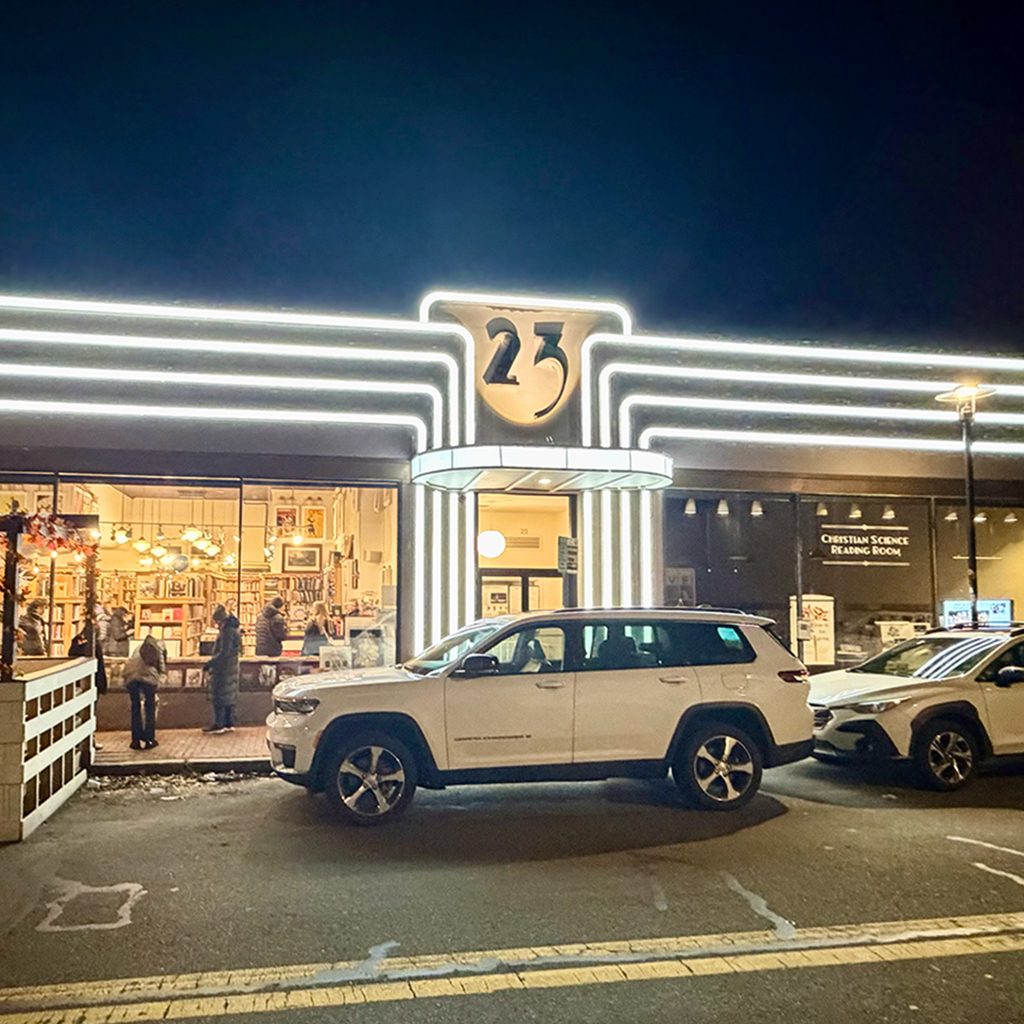
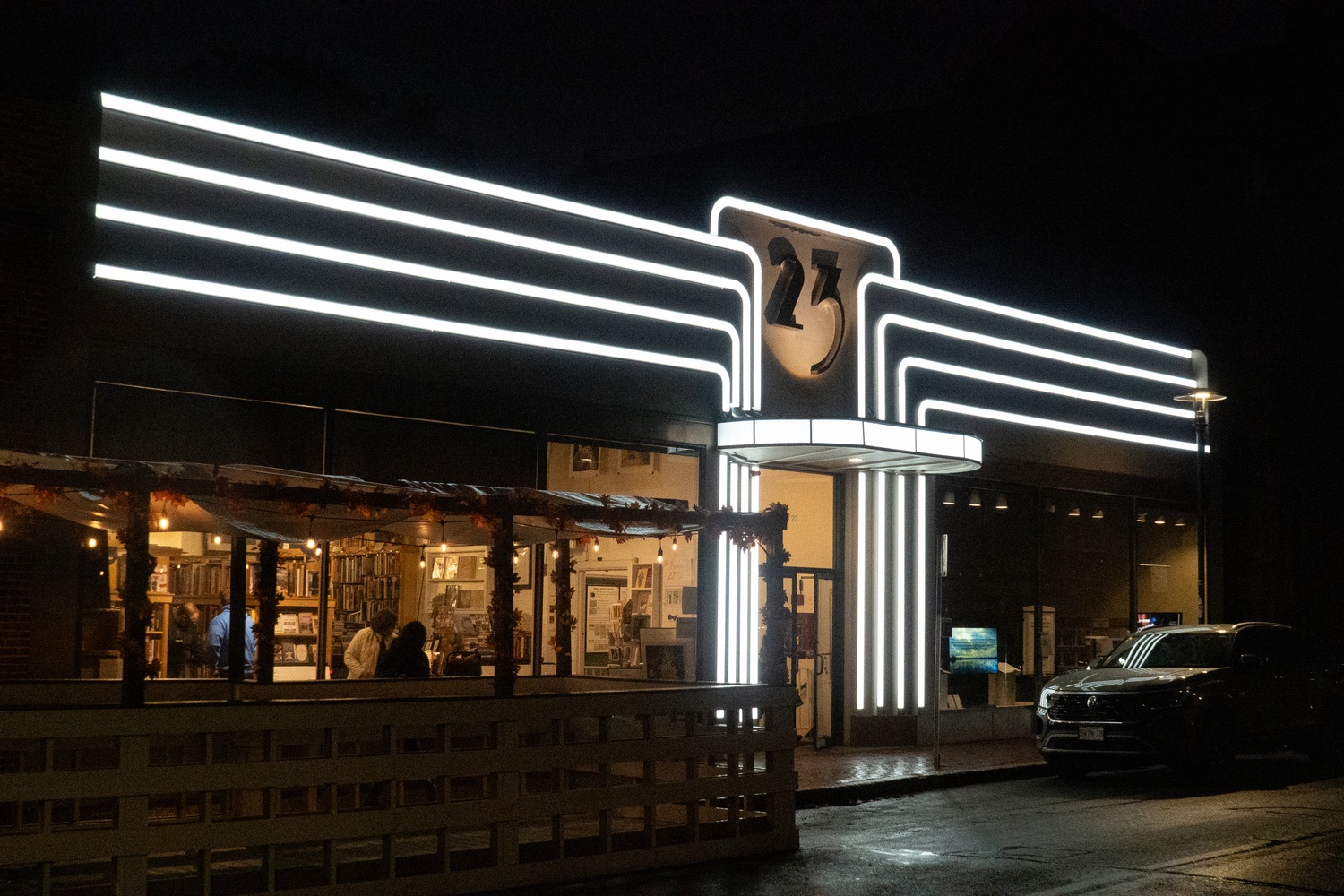
Tom MeekThe restored lighting at the Christian Science Reading Room on Church Street in Cambridge’s Harvard Square.
A burst of brightness came to a gloomy stretch of Church Street last month as the Christian Science Reading Room restored soft white art deco lighting absent from the building’s facade for decades.
The lights returned to Church Street, across from the long-dormant AMC Loews Harvard Square, at a Nov. 7 unveiling. Pictures of the alluring illumination have become a slow-trending wave on local social media.
“Now when you see it, it catches your eye,” said Jason Fredette of Poyant Signs, the New Bedford company that restored the lighting over nine months. “The building looks totally different.”
The first structure at the site was a blacksmith shop in the late 1800s, later a veterinary practice. That became mixed retail at the turn of the century as Harvard Square became more thickly settled and the subway arrived in 1912, said Cambridge Historical Commission executive director Charles Sullivan. The 23 Church St. structure was razed in favor of the current one-story 1936 art deco design by architect William Laurence Galvin as a new, upscale home for Cambridge Gas and Electric Light Co.
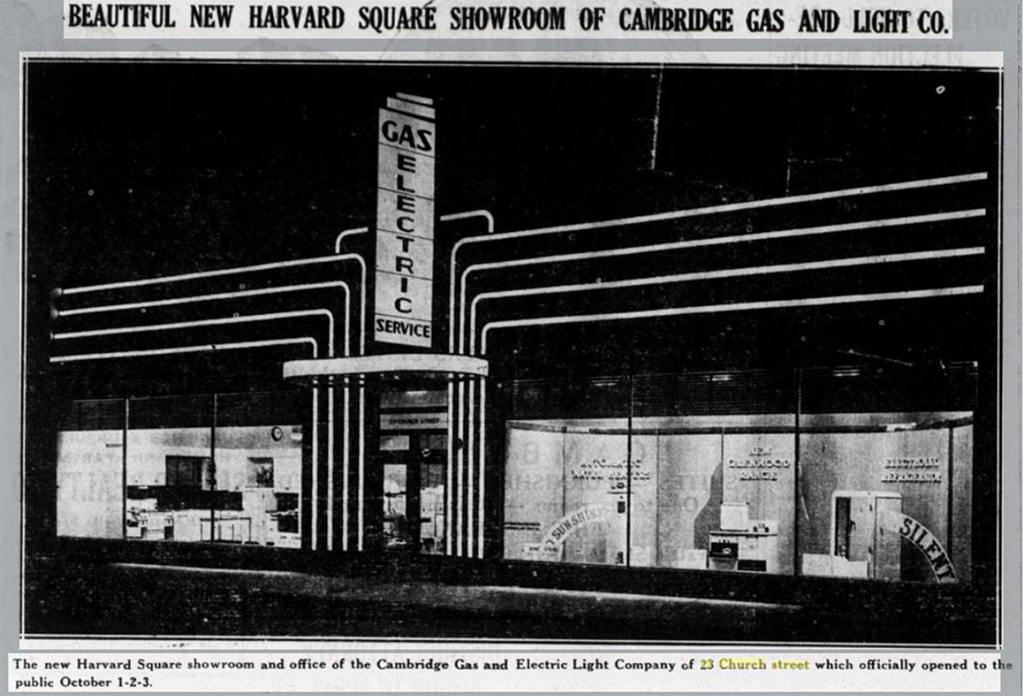
Historical CommissionA newspaper account of the 1936 opening of the Cambridge Gas and Electric Light Co. building in Harvard Square.
Galvin’s design was fitting; the company used the space primarily as a showroom for displaying the latest in energy-related technology such as automatic ranges and hot water heaters, as well as for educational exhibits. The illumination of its curving facade required hundreds of 15-inch incandescent tube lights, each lasting only around 1,500 hours and requiring frequent maintenance. “You were getting up there and two or three of them would be dead,” reading room manager Elliott Reinert said. “They were probably constantly doing it. But they were the electric company.”
The First Church of Christ, Scientist, Cambridge, bought the site in 1947 for a reading room. The other half of the building has always been designated for retail by church management and is occupied by Rodney’s Bookstore.
When the lights disappeared is unclear. Cambridge Gas and Light, now part of Eversource, gave documents to the historical commission in the late 1980s or early 1990s, but it wasn’t until long after that Sullivan reviewed the architectural designs for the building and discovered they included the long-gone lights.
One could deduce the lights went dark and disappeared sometime before the 1947 sale to the church, possibly the result of blackouts during World War II meant to prevent buildings from being targeted for Axis attacks, Sullivan said.
The restoration began with Sullivan’s discovery and was made possible by a preservation grant from the commission, contributions by members of the local church and with effort by Reinert. Securing the funds was easy compared with the work of finding a company to bring the era’s aesthetic back to life.
It was a long process – more than two years of calling more than 50 companies all over the United States, Canada and China, Reinert said. After a first frustrating phase “waiting for the technology to catch up,” Reinert looked up one day in a mall parking lot and literally saw a sign: It was made of molded LEDs, and it was what he knew 23 Church St. needed.
“I finally had the vocabulary. Once I understood what I wanted, it was a matter of finding somebody that was willing to do it – beyond that, it was finding somebody who was really excited about doing it,” Reinert said.
Many of the industrial lighting companies he contacted were not. But one of his calls led him to Poyant in New Bedford. “They wanted be part of art and history,” Reinert said. “Their expertise and enthusiasm was perfect.”
The lighting was part of a bigger restoration of the building that included masonry, roof work and removal of red awnings that had long obfuscated the signature grooves for the incandescent tubes – now filled with modern technology using minimal energy and expected to last years, if not decades.
“We are delighted with the lights and truly appreciative of all the effort and the outcome,” said Denise Jillson, executive director of the Harvard Square Business Association.