RoadTrip N. via YelpGnomon Copy is closing in Harvard Square after more than 50 years.
After more than 50 years in business, Gnomon Copy closes its doors for good on Friday. A short walk from Gnomon Copy’s Harvard Square location is FlashPrint, which is acquiring the closing copy center.
Two MIT graduate students established Gnomon Copy in their dormitory in 1966, according to a 2006 profile in The Harvard Crimson, and went on to open nearly a dozen locations in college towns across New England and New York.
Gnomon Copy originally had two locations in Harvard Square: the location in operation until its closing this week at 1308 Massachusetts Ave. – for a time, it was at 1304 Massachusetts Ave., behind a storefront of large plate glass set into elaborately swirling art nouveau wood frames – and a second location at 99 Mount Auburn St. that was sold in the 1980s to Alan Shapiro.
Shapiro kept the space as a copy center and eventually renamed it FlashPrint.
“There were many copy centers in the area and as they went away, we acquired their business,” Shapiro said.
The owners of the final Gnomon Copy in Cambridge approached FlashPrint to see if Shapiro was interested in buying it too. Shapiro was not looking to buy – but made a deal to pay the Gnomon owners a commission for the business FlashPrint acquired from Gnomon clients over the next few years.
Beginning next week, the Gnomon Copy website, email, and phone number will forward to FlashPrint, and two employees will relocate there. Cambridge Day was unable to contact Gnomon Copy owners.
Gnomon Copy also has a location in Medford, which will shut at the end of the week.
Gnomon Copy played “an important role” in the community, but Harvard Square has “evolved and changed” a lot since the copy center was starting out, said Denise Jillson, executive director of the Harvard Square Business Association. “Copy centers are still relevant, but [without] the demand that [they] used to have.”
The Gnomon Copy storefront on Massachusetts Avenue is owned by Harvard University. It’s not known what business opens in the space next.
Local business leaders in Harvard Square are concerned about the rising tension between the Trump administration and Harvard University.
“The business community around Harvard is very embedded with the university,” said Denise Jillson, executive director of the Harvard Square Business Association. “They live side by side.”
The university’s students are a major source of neighborhood foot traffic and spending, according to Jillson. With the Trump administration cutting Harvard’s funding and trying to end enrollment for foreign students, Jillson said there’s a lot to worry about.
“Thinking about the square, thinking about the next few months, thinking about tourism, thinking about our businesses and the impact of the administration’s actions against the university — and not just Harvard, but what they’re doing relative to funding programs across our region here?” she said. “We’re concerned.”
The business community is watching for potential cuts to Harvard’s staff, too, as the school’s funding is slashed.
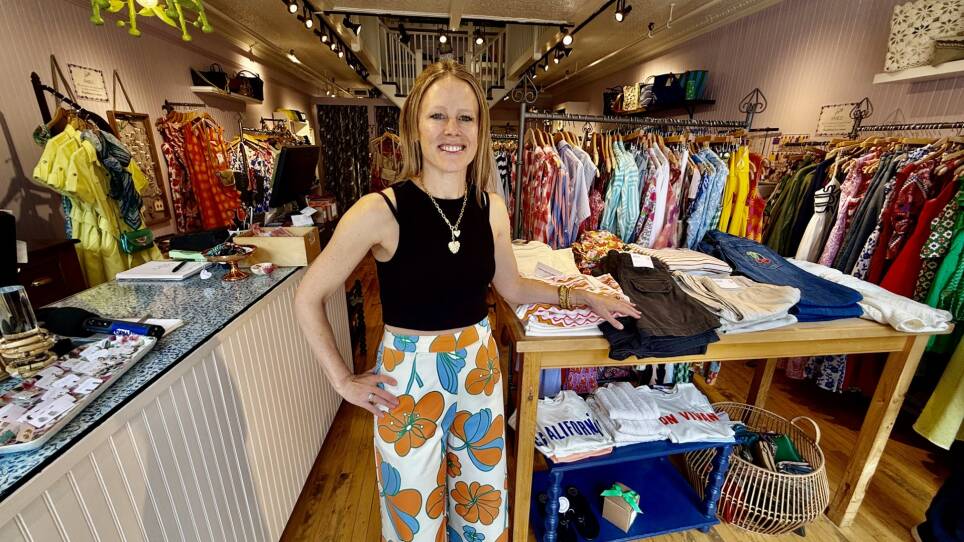
Brooke Garber owns Mint Julep, a women’s boutique, on Brattle Street known for its wide selection of clothing, jewelry and accessories. She says the Harvard campus community is a huge portion of her customer base from their first visit to tour the school through graduation day.
“They shop with us all the way through, right up until commencement — and then sometimes they stay,” Garber said.
Garber worries about the apparent standoff between the White House and Harvard escalating.
“Every day we say, could something crazier happen today? And every day something crazier happens,” she said. “Last week with the assault on the international students, it’s just unbelievable. And a lot of our customers are international and their families are, too, so I hope that it doesn’t come to that because it would be very sad for higher ed in general, but also for tourism in Boston and in the U.S.”
Mint Julep owner Brooke Garber said Harvard’s student population plays a huge role in her business.
Around the corner, Anna Shine owns and operates New England School of English, an English as a Second Language (ESL) program primarily for international students.
“My students spend a lot of money in Harvard Square, a lot of money in Boston and so money spent in Harvard Square is good for everyone, including Harvard. It keeps the businesses alive,” Shine said.
Shine, who is originally from the United Kingdom, says her four-week class typically enrolls about a dozen students who are immersed in local culture while enhancing their English skills.
“Whether you’re a Jew or an Arab, Black or white, when you’re in this environment there’s this environment of kindness and tolerance and acceptance, people come together, and there’s this magic that happens. The power of internationalism,” said Shine. “What happens to all the soft power? What happens to all of the goodwill that goes back to their countries?”
Jillson, who advocates for about 400 members of the Harvard Square Business Association, believes the community will persevere.
“As we look back over the COVID years, even further with the Great Recession, with the dot-com bubble, all of those are within a lifetime,” Jillson pointed out. “We know what that was like and our businesses were able to respond. And we will respond to this, and we will not be defeated, not by our own government.”
Cambridge Day reports on the idea of reusing a tunnel left over from the days when the Red Line ended in Harvard Square instead of continuing to Alewife. The tunnel runs between Mount Auburn and Eliot streets and the John F. Kennedy School.
Print
A Harvard Square T tunnel unused for 40 years might be turned into an entertainment venue
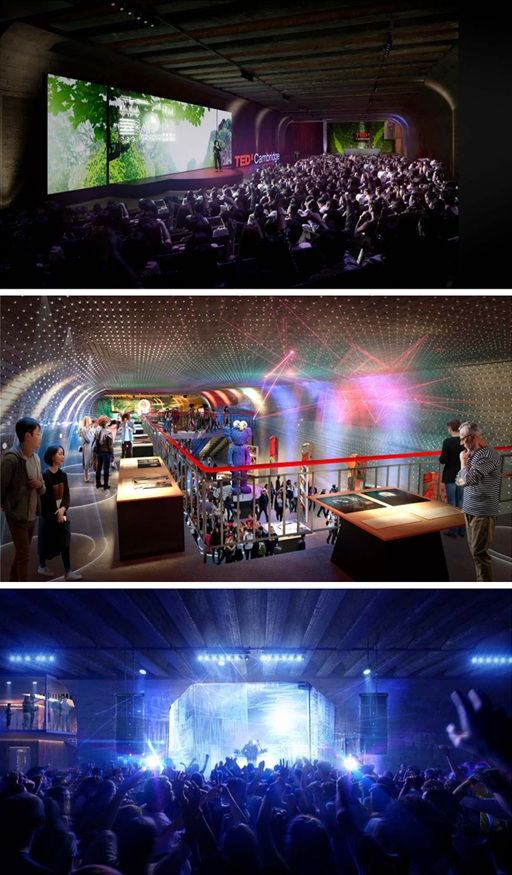
An empty tunnel under Harvard Square could be turned into a venue hosting a variety of events, the Harvard Square Business Association says.
Underneath Harvard Square in Cambridge lies an abandoned MBTA tunnel, unseen by passengers for 40 years. The Harvard Square Business Association proposes to transform it into an entertainment venue – or at least look at the idea seriously.
The tunnel starts at Mount Auburn and Eliot streets and stretches to the Harvard John F. Kennedy School of Government. The MBTA uses some of it for ventilation and other mechanical purposes; aside from transportation workers, the tunnel is accessed regularly by students of the Harvard Graduate School of Design who craft creative proposals for how life could be breathed into it.
Now the association has funding to explore putting the plan in motion.
“It’s something that we’ve been working on for a very long time,” said Denise Jillson, executive director of the HSBA. “It’s been relevant for a long time, but these things don’t move quickly.”
She imagines a revamp that would turning the tunnel into an entertainment venue that’s versatile, artistic and “youthful.”
“You could do a Ted Talk in the morning, you could do an art exhibit in the afternoon and a concert in the evening,” Jillson said.
John DiGiovanni, Harvard Square developer and former president of the HSBA, said the association has been thinking about the project for 10 years and paid for its own 3D imaging of the space to help craft designs – part of some $50,000 to $60,000 in private dollars already put toward the idea.
While the ultimate project would be funded largely by an outside private developer, there have been frustrations in getting to being able to argue the venue would be economically viable and a worthwhile investment as well as a potentially “important economic engine for the city,” DiGiovanni said.
In February 2020 the association met with city leaders and several property owners to outline a plan, then “lost three years the pandemic, then spent the last couple of years working with the city manager,” DiGiovanni said. “He is skeptical about the ability to develop the tunnel into a venue. I appreciate his skepticism and his innate determination to be frugal with public funds. However, there are a variety of reasons why it’s worth spending these initial investment dollars.”
“Ticketed venues are the new anchors for districts,” DiGiovanni said. “We’re late – other districts are doing this.”
Sean Hope, who co-owns the Dx nightclub and event venue in Harvard Square, said the tunnel represents a significant opportunity, considering the challenge of finding more space in a city as old and dense as Cambridge. “This is an opportunity for Cambridge and one of our historic squares to look toward the future,” Hope said. “If you look at Assembly Row, if you look at The Seaport, these all have anchor opportunities and open spaces and something unique to draw them there.”
City manager Yi-An Huang clarified that redirecting $72,000 to find an engineering firm was “reasonable,” but the firm’s study would cost conservatively $500,000 to $1 million, and “who would fund that is unanswered.”
“I have concerns regarding whether the economics would work out – that the significant capital cost and risk would mean that it would be very difficult to bring private capital into a project like this, and ultimately it would have to be publicly funded or there would have to be a pretty significant donation,” Huang said. The refurbishment of the Harvard Square at a reported $3.3 million was on his mind he said – and that structure is small and overground.
A proposal before the City Council on May 12 asked city staff to meet with the HSBA about the tunnel proposal and consider getting started with a study of the idea. A $72,000 request for proposals would be carved out of an existing $300,000 earmarked to study closing off some Harvard Square streets to car traffic. Councillors approved the request Monday, adding the MBTA formally to the discussion.
Councillor Cathie Zusy started as a skeptic and said by Monday she’d come around to the expenditure. “Harvard Square needs a boost, and this could be just the boost that it needs,” Zusy said.
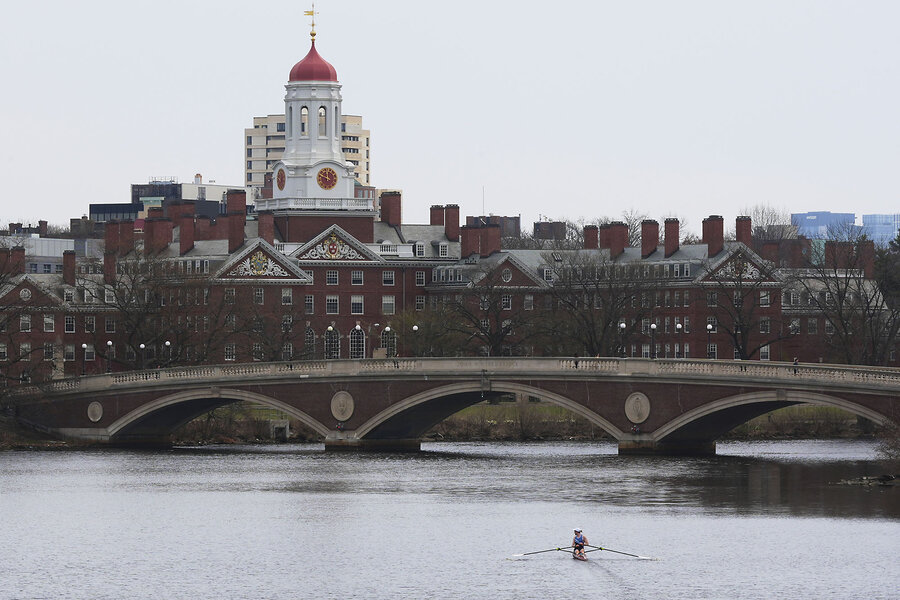
A sculler rows down the Charles River near Harvard University April 15, 2025, in Cambridge, Massachusetts. The Harvard community has unified behind the oldest university in America in the wake of Trump administration cuts totaling $3 billion so far.
Harvard Yard is bustling on a bright day in May. With graduation nearing, large white tents stand ready for celebration. Tourists and Cambridge residents enjoy the sunshine, as Harvard students study al fresco for finals. A few SUVs loaded with boxes are parked on the quad in preparation for the end of the semester.
Those students who were willing to speak to a reporter said they were proud to belong to an institution that is taking a stand for what it believes in. Christoffer Gernow, a first-year student from Denmark, says he’s “very supportive” of Harvard fighting back against the Trump administration, and thinks a lot of other students are, too.
“We’ve never been as united as we are right now” around supporting the university’s decisions, he says. The federal government’s list of demands is, in his view, “completely unreasonable and almost somewhat dystopian,” as well as “contradictory.”
The Harvard community is processing the loss of $3 billion in funding from the Trump administration. But ahead of graduation, students, faculty, and local businesses share what is unifying them – and fueling their pride in the school.
As swiftly as the canceled grants have piled up (so far to a total of $3 billion), so have responses in support of the United States’ oldest and most affluent university. After the university filed a First Amendment lawsuit in April and spearheaded an open letter defending “essential freedom” signed by the presidents of more than 400 universities, donations began pouring in at a rate of 88 an hour, according to The Harvard Crimson.
The floods of goodwill and small-donor donations stand as a strong contrast to a year before, when the university was awash in protests, its first Black president had resigned amid plagiarism allegations and unsatisfactory testimony in Congress on campus antisemitism, and large-scale donors were pulling their support. From faculty and alumni to area businesses, the expressions of pride in Harvard’s stance for academic freedom are effusive. Actions by the White House have galvanized people, they say.
“Trump has a way of unifying people – Canadians, Australians, Harvard faculty, you name it,” says Theda Skocpol, the Victor S. Thomas Professor of Government and Sociology at Harvard.
By Matt Juul Globe Staff,Updated May 21, 2025, 4:29 a.m.
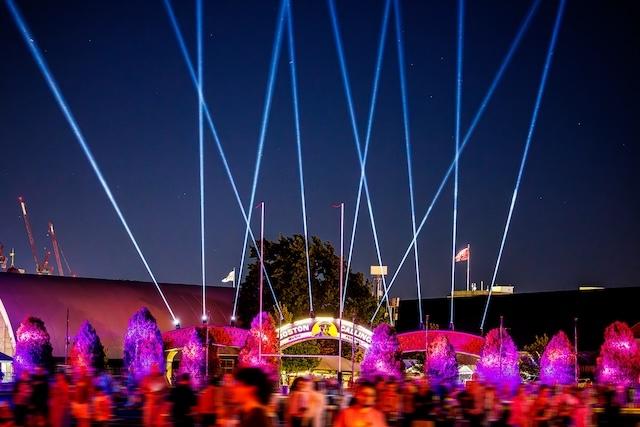
Attendees of Boston Calling take a picture at the entrance of the music festival on May 24, 2024.Erin Clark/Globe Staff
Another rockin’ Memorial Day weekend is on the horizon thanks to the Boston Calling Music Festival, which returns with a new stage, fresh lineup, and three days of fun for local music lovers. From a preview of the weather forecast to set times to everything that’s new, here’s the ultimate fan’s guide to this year’s Boston Calling.
What’s new this year?
Boston Calling has a new look for 2025. Most notably, a massive single stage is replacing the separate Red and Green stage areas that existed in past iterations of the festival. The new main stage also has the ability to rotate, so as one act performs in front of the audience, the next singer or band can prepare simultaneously backstage.
According to a press release, the rotating stage will feature “state-of-the-art sound and video,” with the redesigned festival layout aimed at “making it easier for attendees to move between performances” while mitigating crowd congestion. The changes come after last year’s Boston Calling received some fan backlash over its crowd size.
A map of the festival.Handout
In addition to the new stage, Boston Calling will have more water stations available at the fest to keep attendees hydrated. And if you’re looking to get out of the sun (or rain) and relax, the indoor arena makes its grand return this year. While past iterations of Boston Calling have used the space for stand-up performances and even a film festival curated by Natalie Portman, this year’s fest will utilize the indoor arena to showcase performances by Berklee College of Music jazz students.
Contrary to popular belief, the city doesn’t disappear after midnight. You can get pizza after midnight and burritos until 4 a.m. if you know where to look.
Let’s be honest – Boston has never been known as a late-night city. Last call remains at 2 a.m. – the same as when I was in college, which didn’t really matter because I had to catch the MBTA, which ceases service around 1 a.m. (This was the dark ages before ride-share services.) But that doesn’t mean we don’t know how to party – we just start early.
It’s a short walk from the Boston Calling Festival to late-night eats in Harvard Square.Boston Calling
At 1 p.m., to be precise. That’s when the gates open at Boston Calling, the three-day Memorial Day weekend music festival that attracts more than 100,000 people to the city’s biggest party. This year, organizers tell me that a redesign of the main stage should alleviate the crowd-crunch that happened last year after Chappell Roan (I squeezed behind pop-up tents to escape the fray). This year, I’m looking forward to sets by Sheryl Crow, Remi Wolf, and Vampire Weekend – and the legendary food line-up includes Boston’s best, from Summer Shack and Flour Bakery to Dumpling Daughters and Moyzilla. Not to mention Dunks dishing out free samples of ice cream-flavored coffee drinks. Fingers crossed, the lousy weather will clear out just in time, but if you need a place to relax indoors, check out the new Arena Stage, a covered and air-conditioned space featuring music from up-and-coming Berklee College jazz musicians.
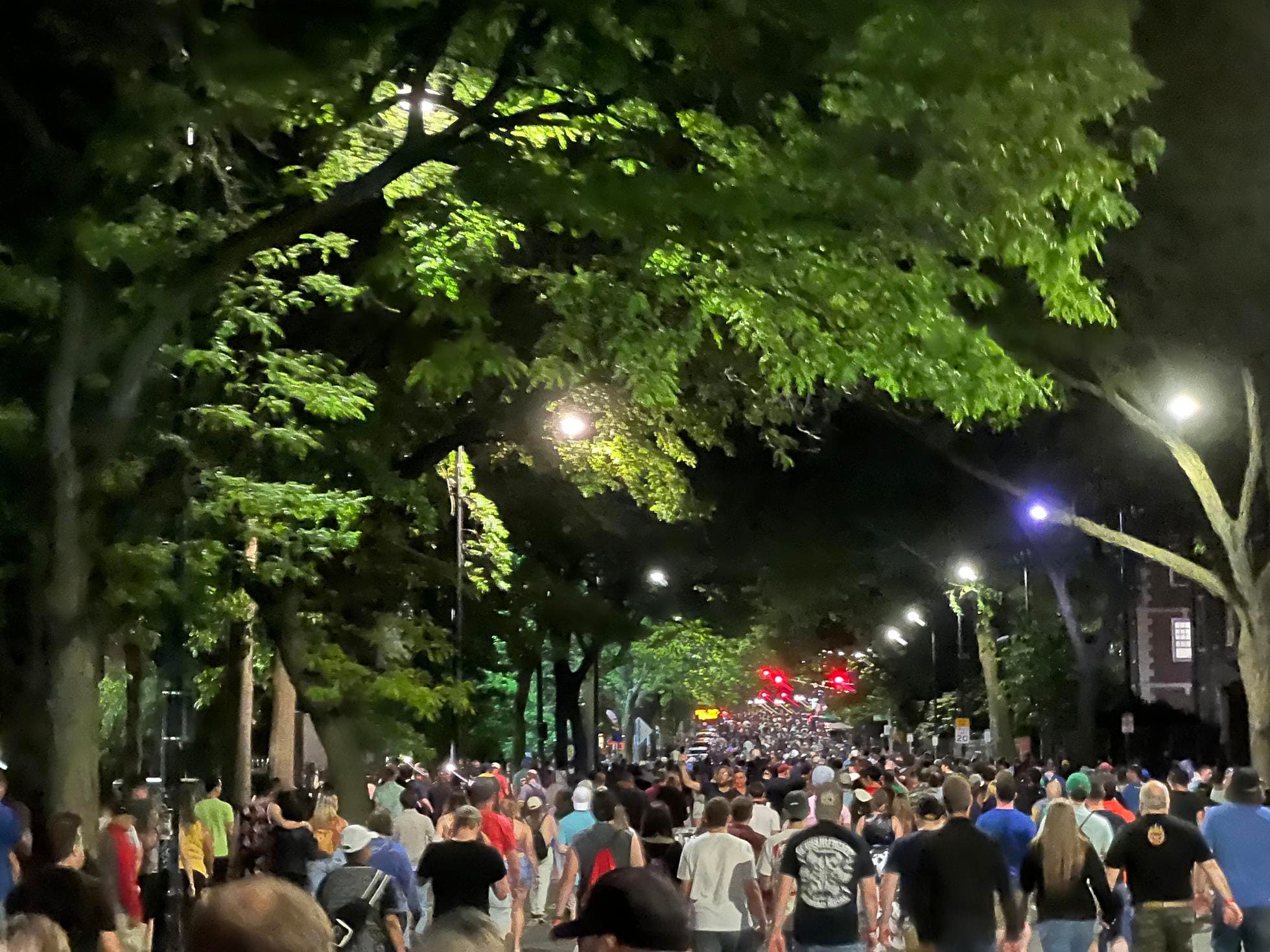
Let the crowds streaming to the T stand shoulder to shoulder while you chill with a burger in a beer garden.Bill Manley
But when you are spilling out of the gates at 11 p.m., you don’t have to head straight home. In fact, don’t even try. While the ride share lot at the festival is actually pretty well-organized chaos, you don’t want to do battle with that demand pricing. And the walk to Harvard Square, which doesn’t actually disappear after midnight, is not that much longer than the walk to the ride share lot.
So chill for a while – grab a drink or a snack. Here are some prime options for late-night eats.
Enjoy a late-night menu from charcuterie specialist Kured in the Garden Bar at the Charles Hotel.Charles Hotel
The Charles Hotel: It’s about a 10-minute walk from the gates to this property, making it a great home-base for the weekend. Rooms are nearly fully booked – at press time there were only five king-bed rooms remaining, at $745 a night. A much gentler option cost-wise is to park in the garage under the hotel, which maxes out at $50 for 24 hours. The hotel’s One Reason Garden Bar is hosting a block party until midnight with music, social media friendly photo ops, specialty cocktails and a late-night menu from Kured. Or cozy up at the hotel’s Noir Bar, open until 1 a.m. with French-inspired cocktails
El Jefe’s Taqueria: Whether the line was too long at this local favorite’s booth inside the festival, or you just need one more burrito heaping with Al Pastor and Mexican rice, the Harvard Square location is open until 4 a.m.
Charlie’s Kitchen: Relax in the beer garden over one of their famous double cheeseburgers until midnight at this 76-year-old spot.
Grendel’s Den: The kitchen closes at 11:30 pm, but you can drink at this snug —and historic—underground bistro until 1 a.m.
Pinocchio’s Pizza : Craving an old-school pizza? The big decision is Sicilian or thin-crust at this spot that has been slinging pies for fans (including Ben Affleck and Mark Zuckerberg) since 1966. Seating is only at a couple of small tables, but they serve until 2 a.m.
Van Leeuwen Ice Cream: Does a scoop of Brown Sugar Cookie Dough Brownie ice cream sound like just the right ending to your day? The Harvard Square location of this booming chain is open until midnight.
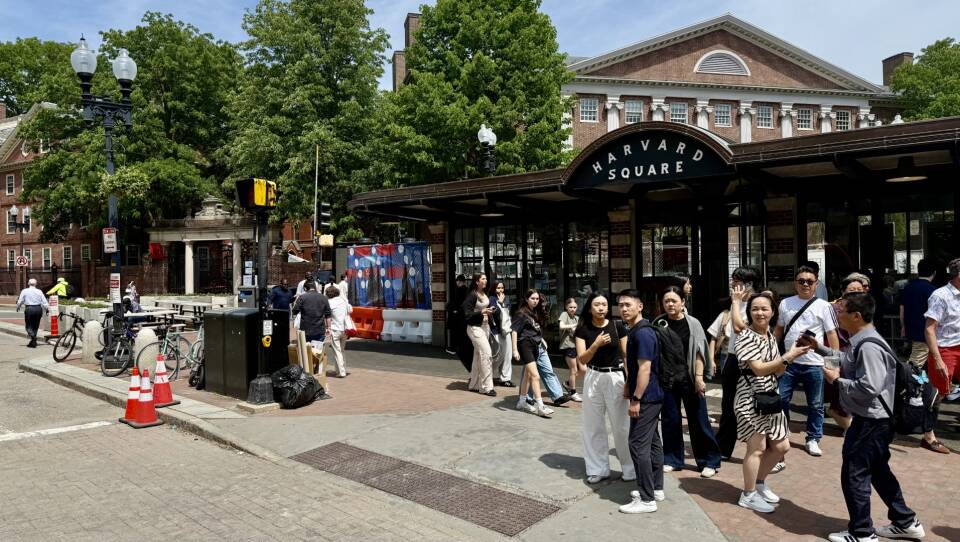
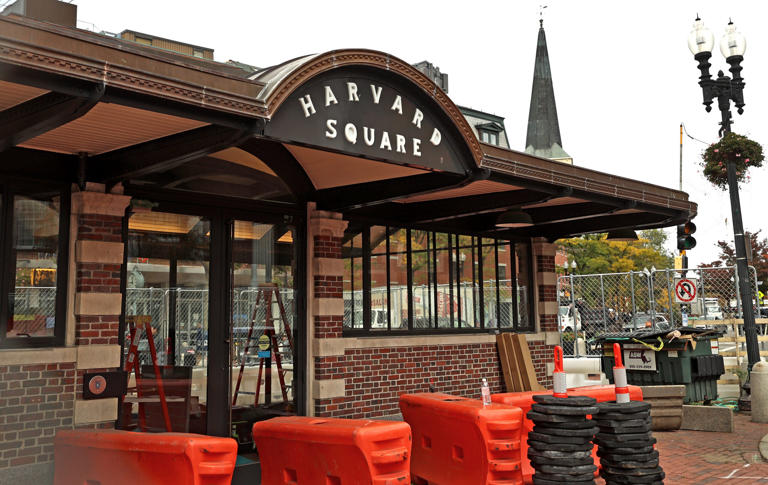
The historic kiosk and former newsstand in the middle of Harvard Square will reopen next Friday for the first time in more than five years.
The historic kiosk, stylized as the Cambridge KiOSK, will open in partnership with the Cambridge Office for Tourism and Somerville-based nonprofit CultureHouse, the city announced. The landmark will be a “cultural incubator, community gathering space, and visitor information center,” the city said.
The plans to open the kiosk, which has sat at the mouth of the MBTA stop for nearly 100 years, as a community space were announced in October of 2024. The city will celebrate its grand reopening May 30 between 10 a.m. and noon with a ribbon cutting and live music. Continue reading
The ceremony will also debut the inaugural exhibit, “a pop-up newsstand celebrating Cambridge’s rich print media history,” inside the Cambridge KiOSK, the city said.
The historic kiosk has been vacant since longtime Cambridge landmark Out of Town News closed in 2019.
The kiosk, originally built as an entrance to the subway in 1927, was the natural center of the square. It began operating as a newsstand in 1983. The kiosk was listed on the National Register of Historic Places in 1978, and a Cambridge Landmark in 2017. The rotating exhibit will, in part, honor the newsstands’ legacy, the city said.
Since 2019, the kiosk has been under seemingly perpetual construction, sometimes surrounded by a chain link fence, in the middle of Cambridge’s most popular tourist spot. The Boston Globereported that the construction cost $3.3 million, or about $6,600 per square foot.
Other events planned for the Cambridge KiOSK include open mics, art workshops, historical exhibits, and stand-up comedy. CultureHouse is promoting an interest form for local artists, organizations, and businesses to pitch events and activities at the site.
“Out of Town News once brought global conversations to Harvard Square when news from overseas was hard to access,” CultureHouse Executive Director Aaron Greiner said in a statement. “Today, information from around the world is readily available on our phones, but it’s local connections that are often hardest to find.”
The Cambridge KiOSK’s new hours will be on Sundays from 10 a.m. to 8 p.m., Mondays through Thursdays from 9 a.m. to 8 p.m., and Fridays and Saturdays from 9 a.m. to 10 p.m.
The Cambridge Visitor Information Center, which was temporarily located in a nearby bank, will reopen in the historic kiosk. In a statement, Cambridge City Manager Yi-An Huang called the reopening “a milestone for our community.”
“This transformation respects the KiOSK’s rich history while creating new opportunities for gathering, creativity, and civic engagement in the heart of Harvard Square,” Huang said. “We are excited to see it thrive as a welcoming hub where residents and visitors can connect and celebrate Cambridge’s cultural vibrancy.”
The kiosk’s restoration is a part of overall construction to Harvard Square’s central plaza, which is set to be completed in the fall of 2026.
Renowned Cambridge club a perfect venue for students’ final presentations, focused on the highs and lows in the city’s musical heritage
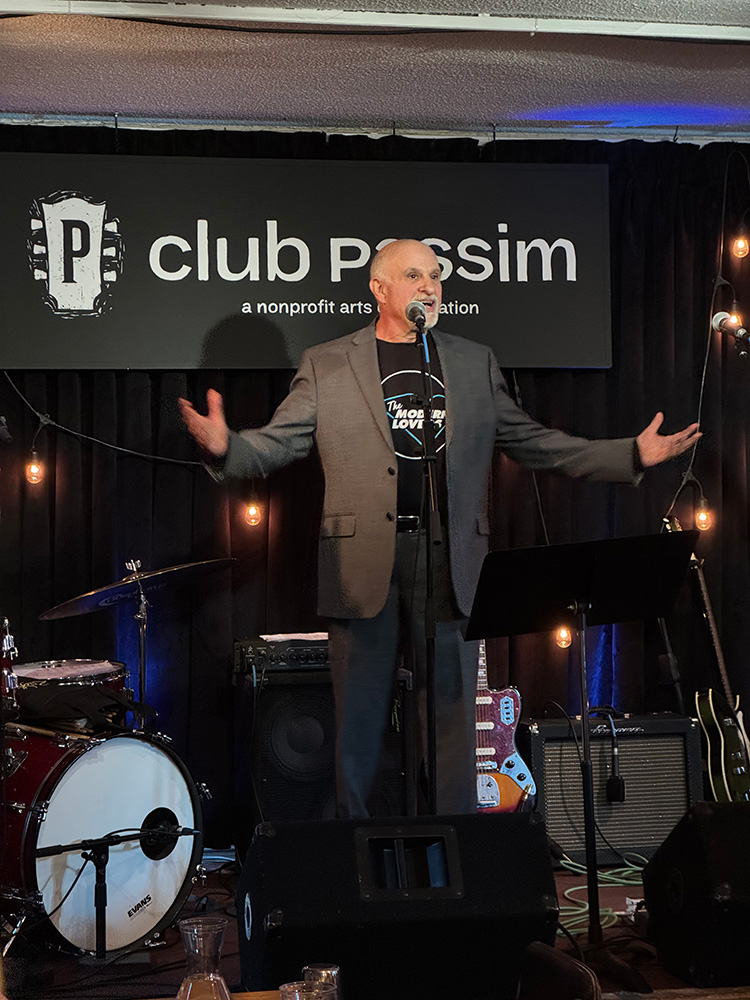
History, like music, pulses with recurring refrains. Today’s battle over immigrant rights echoes a controversy, aptly, from Boston’s musical history. Boston University students explained that episode last week on an equally apt, if unorthodox, stage: Club Passim, Cambridge’s iconic folk music venue.
Beantown’s musical heritage provided the theme for the final projects in this spring’s History of Boston class. One student team focused on the Boston Symphony Orchestra, including the World War I–era deportation of its conductor, Karl Muck, without any evidence that he’d aided his native Germany in the war. That exculpatory detail drowned in a flood of foreigners-damning press coverage, whose headlines the students flashed on a screen: “Dangerous Aliens Face Deportation,” “Alien Enemies Leave Boston Sunday.”
“Muck’s arrest was weaponized by these publications and used to grow a general xenophobic attitude towards European immigrants,” Charlotte Waeschle (COM’28) noted during her team’s presentation. The publicity’s effects rippled, added Shreeya Kulkarni (CAS’28), as “immigrants hid their cultural identities and even changed their names, and German [American] newspaper publications and schools [and] churches declined in attendance or shut down altogether.”
Other student teams addressed the role Arthur Fiedler (Hon.’51) played in in popularizing classical music as conductor of the Boston Pops for five decades, beginning in 1930; the city’s vibrant jazz scene after the Second World War; the question-authority vibe of punk music in the 1970s; and the role of Passim itself as greater Boston’s folk headquarters and launching pad for the careers of Joan Baez, Joni Mitchell, and Bob Dylan. After the presentations, the students were treated to a buffet dinner and band: musicians, led by guitarist/vocalist Sean Staples, rocked the house with selections from two defunct local bands, Treat Her Right and Morphine.
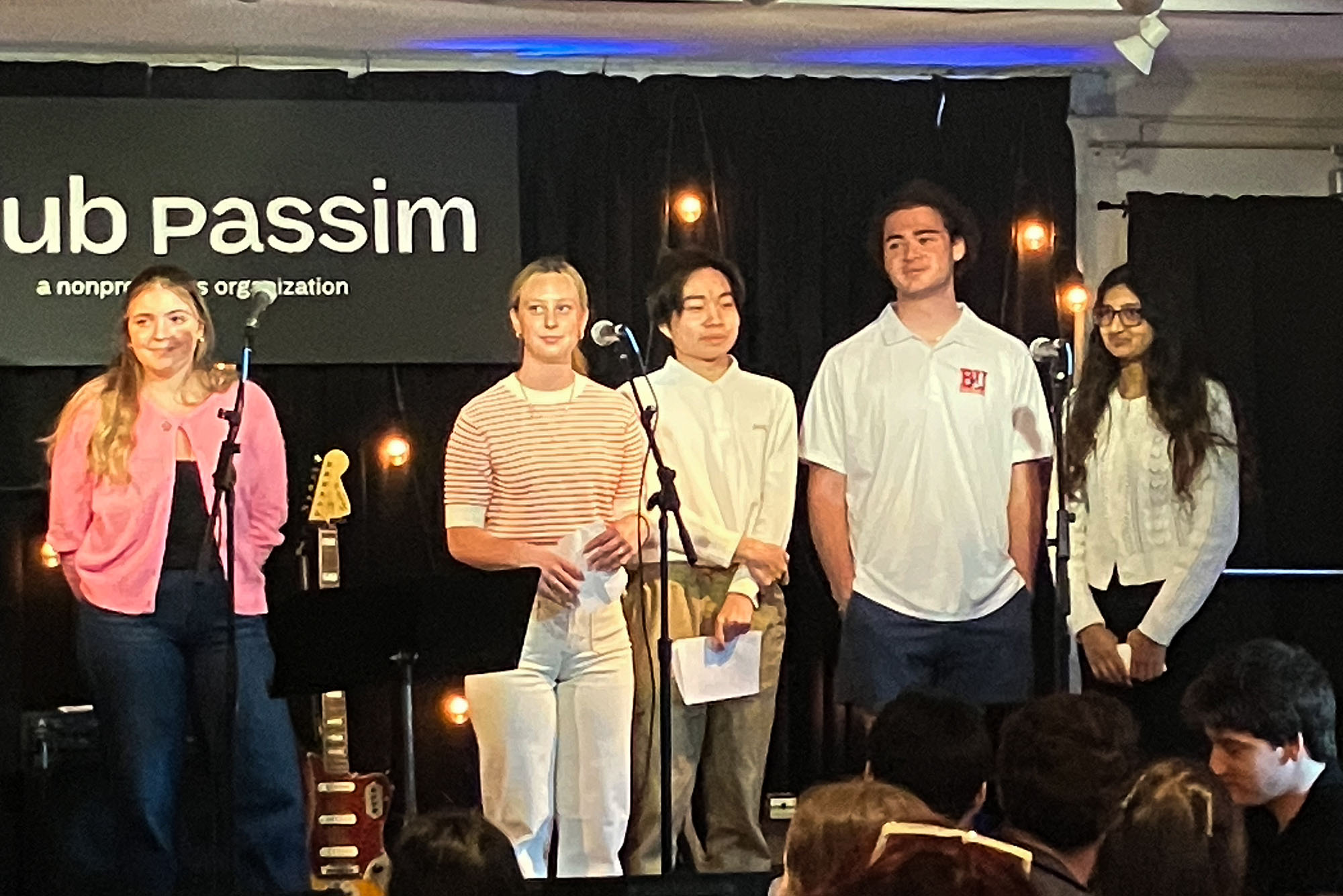
Charlotte Waeschle (COM’28) (from left), Sarah Turner (CAS’26), Yishan He (CAS’28), Emmett Leonard (Questrom’28), and Shreeya Kulkarnie (CAS’28) took to the stage at Harvard Square’s famous Club Passim to present their final project on Boston’s musical heritage.
Few students get to present on a storied stage for their final projects, or are feted by a concert afterward. Bruce Schulman, William E. Huntington Professor of History at the College of Arts & Sciences, never received musical accompaniment when he was a young history major, either. But in his History of Boston class, students don’t just study the past—they immerse themselves in it.
And Schulman, a 2025 Guggenheim Fellow, knows a thing or two about immersive teaching that grabs the attention of students by the lapels. “They never knew that doing history is not just memorizing a bunch of names and dates,” he tells BU Today. Throughout the semester, he introduced students to the city where they study via walking tours and the Passim finale. “One of the most often-stated reasons of entering students here for why they picked BU, is the Boston location. But I think the number one regret of graduating seniors is staying in the BU bubble–‘Didn’t really see much of Boston,’ ” he says.
Schulman knows the manager of Passim and arranged to rent the club for the class presentations—which were given before an invited audience of his friends and academic colleagues—while recruiting Staples, whom he had previously seen perform. Since this was a class about Boston and music, Staples chose to play repertoires by Treat Her Right and Morphine, homegrown bands.
“To my ears,” he says, “they’re two of the best acts to ever come from this area, yet never achieved the visibility of bands like Aerosmith or the Cars. Both groups were also the product of a uniquely Cambridge music scene… I figured a celebration of two incredibly cool yet mostly unknown bands that rose from the neighborhood pubs of Cambridge would be appropriate.”
Like the city it covers, the History of Boston class is always changing. Each year, the course students are assigned a main project with a different theme. Among past topics: the 17th-century King Philip’s War, the Salem witch trials, and the city’s public parks. This semester, Schulman opted for Beantown’s musical heritage, partly as “a form of self indulgence,” he admits
“I’m a big music fan. I see live music a lot,” he says. Beyond that, “Music was also a way of exploring a lot of other important themes in the city’s history, the development of the public infrastructure and architecture, race relations, class relations,” all of which his students also studied this semester. (The class subtitle is Community and Conflict.)
During the last class before the presentations, Schulman coached students on prepping for the big night at Passim, suggesting that dressing up wasn’t necessary for a music club—but they shouldn’t dress down too much, either (“Don’t be wearing what you would mow the lawn in”) He also encouraged them to applaud their peer presenters and the musicians. And while it wasn’t required for when he stepped on stage: “You are absolutely permitted to clap and cheer wildly.”
He has alternated teaching the class with colleagues for about 12 years. A key takeaway—conveyed by tapping into Boston as a living laboratory-—is that history isn’t made only by great forces and people who came before, but by those who study them as well.
Plus, expansions for Anna’s Taqueria, Mr. Tamole, Post 1917, and more.
By Kara Baskin Globe Correspondent,Updated May 8, 2025, 12:00 p.m.
A burrito assortment at Anna’s Taqueria, new in Natick.
Coming soon: All-day café Daily Provisions opens this summer in Harvard Square (1 Brattle Square), new from New York restaurateur Danny Meyer’s Union Square Hospitality Group. As we reported in March, Meyer will also open another Daily Provisions, plus Italian restaurant Ci Siamo, at Commonwealth Pier in the Seaport this summer.
In an earlier interview, Daily Provisions culinary director Claudia Fleming recommended crullers; Mediterranean tuna sandwiches with tapenade; and roast chicken.
“We’re there all day, for whatever you want,” she said.
Canadian chain Cactus Club Café opens in the Back Bay later this year (500 Boylston St.), marking its 34th location. It’s big — 9,500 square feet, with lounges, all-season patios, and al fresco spots — with a large menu, too, ranging from burgers to tacos to curries, pastas, and steaks.
On the South Shore, Salty Days Fish Co. (1 Shipyard Drive) brings patio-service cocktails, sushi, and seafood to Hingham’s Shipyard this summer, joining a sibling location in Cohasset.
In Foxborough, Patriot Place (2 Patriot Place) launches a suburban location of Downtown Crossing’s Estella this summer with an eclectic menu: chicken wings, yucca fries, Haitian spaghetti, lobster ravioli, and Hungarian filet mignon.
And in Lexington, look for a second outpost of swanky Reading steakhousePost 1917 in June (27 Waltham St.).
Openings: The Boston Public Market (100 Hanover St.) gets spicier with the addition of Mr. Tamole, softly opened this week. Andres Medina-Carreto and his mom, Margarita Carreto, began with a mobile food stand, serving tamales with their signature, family-recipe mole sauce, which is vegan and gluten-free. At the Market, they’ll serve tamale plates with red, green, or mole sauce; tacos (including a potatoes and jalapenos version); and chilaquiles (which the menu cheekily notes are helpful during hangovers).
CanalSide Food + Drink at CambridgeSide (47 CambridgeSide Place) welcomes Chilacates (Mexican street food) and Fresh (smoothies, sandwiches, and acai bowls) to their food hall, joining established vendors like Lala’s Neapolitan-ish Pizza and Nu Burger.
And in Natick, Anna’s Taqueria opens on Tuesday, May 13, with a 2,000-square-foot restaurant and patio space (1265 Worcester St.). Exclusive to this location: corn tortillas made to order. Visit daily from 10 a.m. until 10 p.m.



 Continue reading