Print
WBUR

A ‘radically inclusive’ brass band believes anyone can learn to play

August 08, 2025

Ali Boreiko plays at an an impromptu School of Honk performance at Harvard's Science Center Plaza, in Cambridge, Mass. (Robin Lubbock/WBUR)
Ali Boreiko plays at an an impromptu School of Honk performance at Harvard’s Science Center Plaza, in Cambridge, Mass. (Robin Lubbock/WBUR)

On a Sunday in April, Cambridge Common reverberated with the discordant honks and trills of a brass band warming up. Musicians arrived at the park with instrument cases strapped to their backs and slung over their shoulders, or rummaged through a bin full of trombones set out on the ground. Someone tooted serenely on a sousaphone painted with polkadots.

Polkadots are the official uniform for School of Honk, a community brass band that takes a radically inclusive approach to music education. Even on an unseasonably chilly spring day, around 80 people of all ages showed up to the band’s weekly practice.

The group circled up. Dana Gauthier, one of several volunteers in charge, explained the schedule for the afternoon and offered some ground rules for the uninitiated.

“The goal of School of Honk is to have fun,” Gauthier declared. “One way to have some fun is to not worry about wrong notes.”

Next, the group ran through a couple songs — “Stay Human” by Jon Batiste and “Tightrope” by Janelle Monae — and split into sections by instrument. The freshest recruits were assigned “newcomer buddies” for one-on-one attention.

Over with the drums, George Zollinger offered some pointers to a new School of Honk member named Elliet Fisher. Zollinger wore a puffy red-and-white polka-dotted hat that looked like a toadstool mushroom.

“So you’re basically trying to hit the rivet,” Zollinger explained. “And you’re stick’s about a third of the way in.” He gave the edge of the drum a crisp thwack.
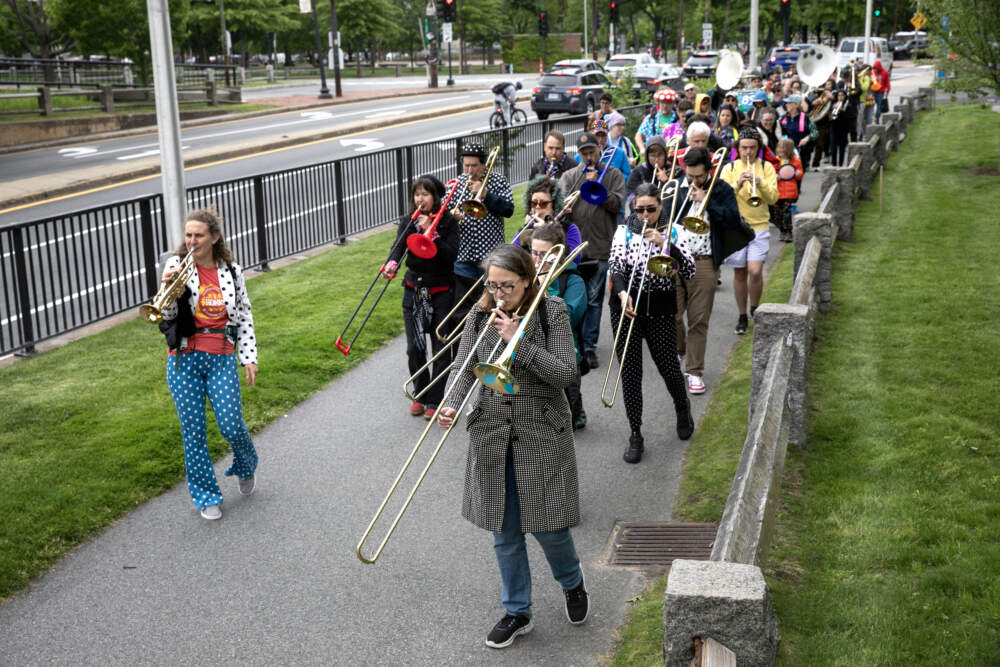
The School of Honk goes on a practice march along Cambridge Street, in Cambridge, Mass. (Robin Lubbock/WBUR)

It was Fisher’s first time trying drums. It’s not uncommon for people to show up at School of Honk and pick up an instrument they’ve never touched before. Mike Ames, of Lexington, began his brass instrument journey when, after seeing brass bands play in New Orleans, he searched for something similar in Boston.

“School of Honk came up, and I’m reading the description and I’m like, ‘Well, this is a little weird,’” Ames recalled. But he went to see the band perform anyway. “The guy at the back of the parade said, ‘Oh, you can join this band.’ … And so I went, like, the next week.”

By the end of that first practice, Ames found himself marching along in the very same parade he had watched as a spectator, gamely trying to follow along on a green plastic trombone.

Every School of Honk practice ends with a parade. That way, even the most inexperienced musicians get to perform. There is a dance troupe, too, so that non-musicians and even bystanders can join in. School of Honk accepts all comers, but it is especially geared toward people who may be new to music entirely.

“We start with lively, lovable songs that are arranged in such a way that someone could play just a very simple, but very important part to that song,” explained Kevin Leppmann, the executive director of School of Honk.
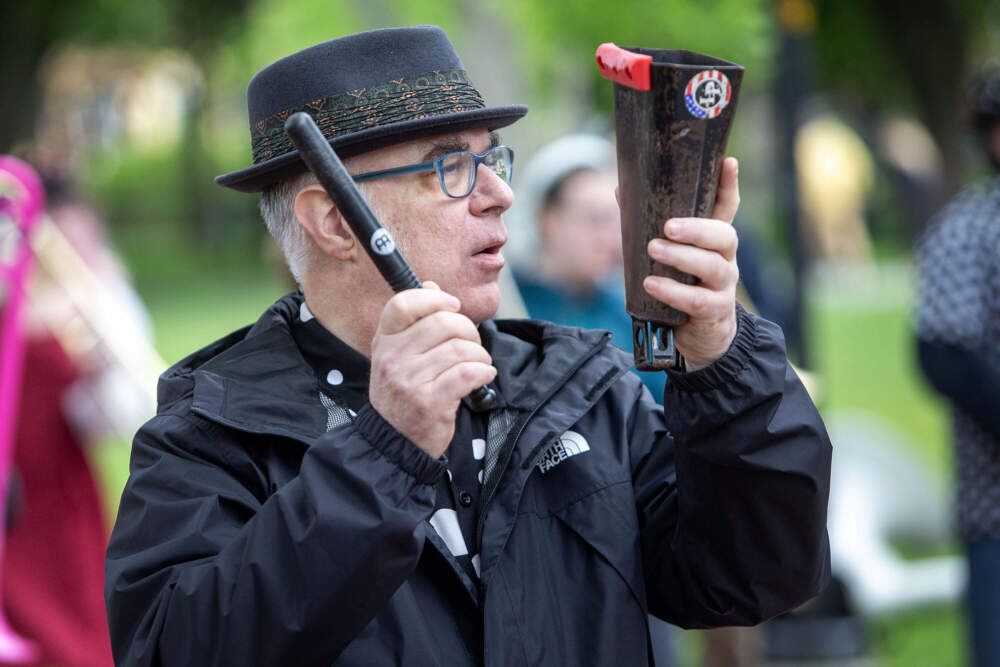
School of Honk founder Kevin Leppmann leads a practice on Cambridge Common, Mass. (Robin Lubbock/WBUR)

Leppmann founded School of Honk 10 years ago. A trombone player, he had been involved in the founding of HONK! Festival of Activist Street Bands, a popular event in which brass and street bands from all over the world converge for one October weekend in Somerville’s Davis Square. Leppmann wanted a way to continue the fun beyond the festival itself.

“The idea was to start a community, a school, that would recreate what was happening at the HONK! Festival, every Sunday afternoon,” Leppman said.

From the start, Leppmann designed School of Honk as an antidote to traditional music education. He noticed that kids who struggle to easily master an instrument often decide music just isn’t for them. They carry that belief into adulthood, which makes it even harder to pick up an instrument later on in life.

“Our society in general really evokes this notion that the best music is music that’s performed by professionals, people who have been training all their lives to make music,” Leppmann said. “And the role of everyone else is to consume it.”

Leppmann wants to model a different relationship to music, one unconcerned with perfection and more attuned to music’s ability to foster community.

“We’re trying to do something very different with it,” Leppman explained. “Which is to get people not just to express themselves and realize a piece of themselves, but to see that expression in others and form a connection with other people.”

The strategy seems to be working. Attendance at weekly practices remains high, and School of Honk now offers a summer camp session for musicians age 10 and up. The group plans to raise money to secure a permanent rehearsal space in the near future.
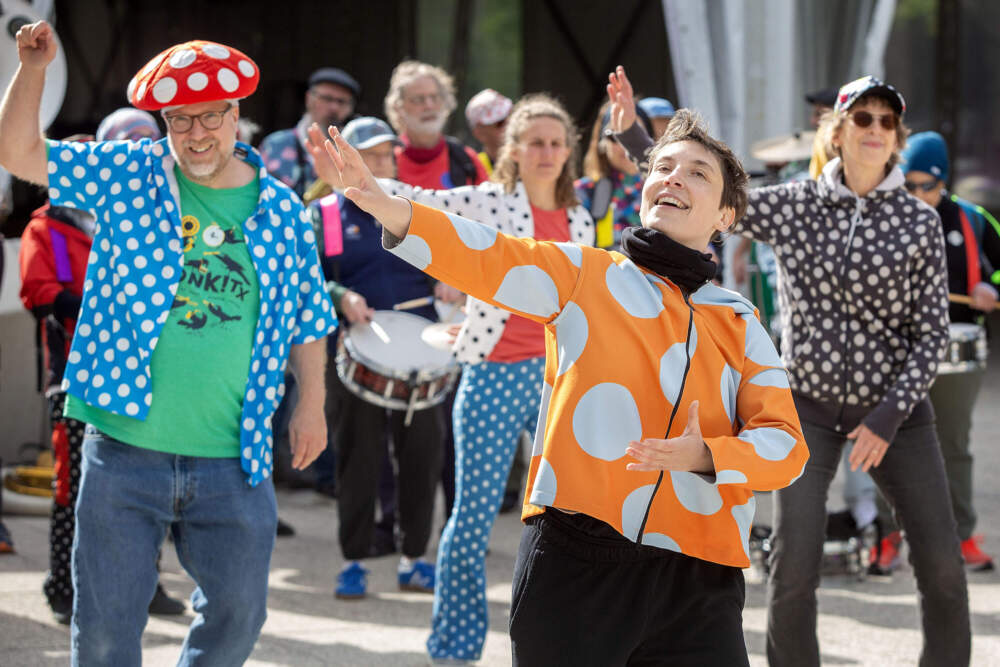
Rosalie Norris leads a troupe of Honk dancers at an impromptu performance at Harvard's Science Center Plaza, in Cambridge, Mass. (Robin Lubbock/WBUR)
Rosalie Norris leads a troupe of Honk dancers at an impromptu performance at Harvard’s Science Center Plaza, in Cambridge, Mass. (Robin Lubbock/WBUR)

For many School of Honk members, the band represents a chance to rewrite the story they’ve long told themselves about their innate musical abilities.

“ I had played trumpet in middle school for like one year, and I didn’t like it,” said School of Honk member Megan McLaughlin. “I wasn’t good at music, I didn’t like reading the music. And I just quit.”

A friend convinced her to come to a School of Honk practice. McLaughlin again picked up the trumpet, and again struggled. This time, she stuck with it.

“ The first time I came, they played ‘Video Killed the Radio Star,’ and in the middle they do a trumpet solo,” McLaughlin recalled. “I was like, ‘One day, I am doing that.'”

Nearly 10 years later, she has taken more trumpet solos than she can count.

At the end of the April practice, School of Honk set off down Mass Ave., a river of polkadots stretching most of a city block. Fisher, the new drum recruit, marched along with his newcomer buddy, Zollinger. At one point, Fisher made a very audible mistake, and the two burst into laughter.

Zollinger reassured him. “You did it, though,” he said, as the band cranked back up.

This segment aired on August 8, 2025.

Print
Boston Globe

‘Even in a snowstorm, they’ll come.’ Lori McKenna returns to Passim (and her devout audience).

By Marc Hirsh
Published Dec. 16, 2025

Lori McKenna will perform four consecutive shows at Passim this weekend. • Becky Fluke

Lori McKenna knows that it’s not always easy for folks to carve out time to attend concerts during the busy holiday season. She’s been on the other side of it, after all.

Back in December 2007, when McKenna began what would become an annual tradition of end-of-year performances at Club Passim, she was a respected folk singer and songwriter who had just begun making inroads into the Nashville establishment. With early champions in Faith Hill and Tim McGraw, McKenna had started down the path that would eventually win her three Grammy Awards for best country song.

The Stoughton native was also committing to shows in the thick of the holidays as a mother of five, whose youngest child was 3 years old.

“We look back now and there are years when my husband was like, ‘Why are you doing this right now?,’” McKenna said with a laugh over a videoconferencing app. “We look back, like, ‘How did we do this when the kids were all those ages?,’ like when you had Christmas choir and you had all these other things [to attend]. ‘How did we do it?’”

As McKenna prepares for this year’s shows (two each on Saturday and Sunday), she remains grateful and maybe a bit awestruck by the people who make their way to Harvard Square every December. And not just because it’s so close to Christmas.

“Year after year after year, the audiences make this show,” said McKenna. “Even in a snowstorm, they’ll come. There’s been years where we’ll go out at the end of the night and there’s 6 inches of new snow on our car. It blows my mind that they just show up. They just support, and at the busiest time of the year. I mean, you couldn’t drag me to something this time of year other than this show.”

McKenna laughed as she said that last bit — McKenna laughs a lot — but she’s aware of the power of her Passim audiences, who provide her with inspiration when she worries she’s lacking in that department.

“Unless there’s something really outside of myself, like if I’m not feeling good or something like that, it’s hard for anything else to have more control over a show than the audience,” she said. “Especially in that room. You can really tell their energy. You can really communicate with them well. They know they’re in for a group experience.”

If Passim is a special place for McKenna, then McKenna is a special artist for Passim. This past fall, the club’s School of Music offered “Songs of Lori McKenna,” a course where aspiring songwriters learned composition using songs like “Humble and Kind” (the McGraw hit that won McKenna her second Grammy) and “People Get Old” as guideposts. It was a nod of appreciation and validation, and McKenna was unaware of it until I mentioned it to her.

“I don’t think I knew about that!,” she said. “Oh my God, that’s so cool.”

Even as her songs are held up as models to aspire to, though, McKenna remains, well, humble and kind.

“I kind of dumb everything down a little bit,” she said. “My songs are quite simple. So maybe it’s good to have a class for people that are trying to figure out. ‘How does she cheat so well, to be able to do this so long?’”

McKenna credited a similarly modest virtue for her success as a songwriter in demand for acts such as Carrie Underwood (“Cry Pretty”), Little Big Town (“Girl Crush”), and Lady Gaga (“Always Remember Us This Way”): consistency.

“At the end of the day, you just have to put your head down and write the best song you can that day,” said McKenna. “Songwriting is really the only thing that I could literally do for 15 hours straight and I could literally talk about forever, because I just think it’s so interesting, and we learn so much about each other.”

Sometimes McKenna’s audience interprets her songs in ways that she hadn’t anticipated. Take, for example, “Happy Children” from her 2023 album “1988,” whose chorus is structured around a series of openhearted blessings that end on “But if you only get one thing that’s a given/ I hope you have happy children.”

An anxious parent inclined to get in their own head might get knocked for a loop by that, and pull darkness and doubt from an obviously kindhearted song: Is my child a happy one? Am I raising him in such a way that he’ll be happy? And hearing this, McKenna still gets excited about how deep her songs can cut.

“I never really thought of it the way that you heard it, and that’s the thing that’s great about songs. You and I can sit right beside each other and hear exactly the same thing and hear it two different ways,” McKenna said. “I think that that’s what’s so beautiful about any kind of art, is people sharing it and then people figuring out what it means to them.”

It all comes back to connection for McKenna, whether it’s to an intimate crowd in a small folk club, a mass audience via country radio, or one father listening alone in his car.

“As [fellow singer-songwriter] Mary Gauthier says, songwriting is a service industry,” said McKenna. “If my job as a songwriter is to make you feel something, then that’s a pretty damn good job to have. It’s a blessing, and it’s for the person sitting in the fold-out chair. It’s not for you. It’s not for the creator as much as for the ears of the people who listen.”

That approach to music has kept McKenna’s perspective on her success similarly modest.

“Anything that I’ve had as far as a feather in the career cap has been because of luck,” she said, “and because I just keep trying.”

LORI MCKENNA BAND

At Club Passim, 47 Palmer St., Cambridge, Saturday, Dec. 20, and Sunday, Dec. 21, shows at 5 p.m. and 8 p.m. both nights. Sold out.

Print
Cambridge Day

Church Street sees the light again

By Tom Meek
Friday, December 5, 2025

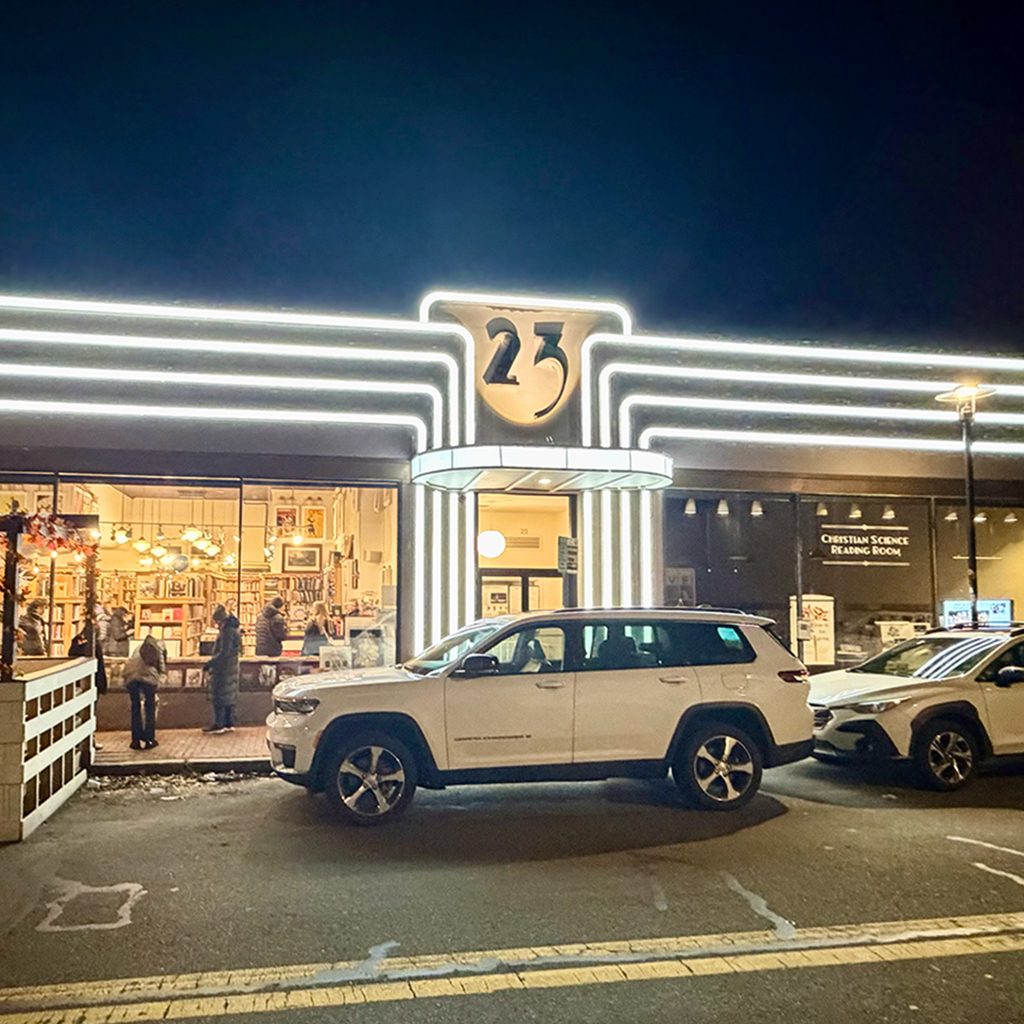
Tom MeekThe restored lighting at the Christian Science Reading Room on Church Street in Cambridge’s Harvard Square.

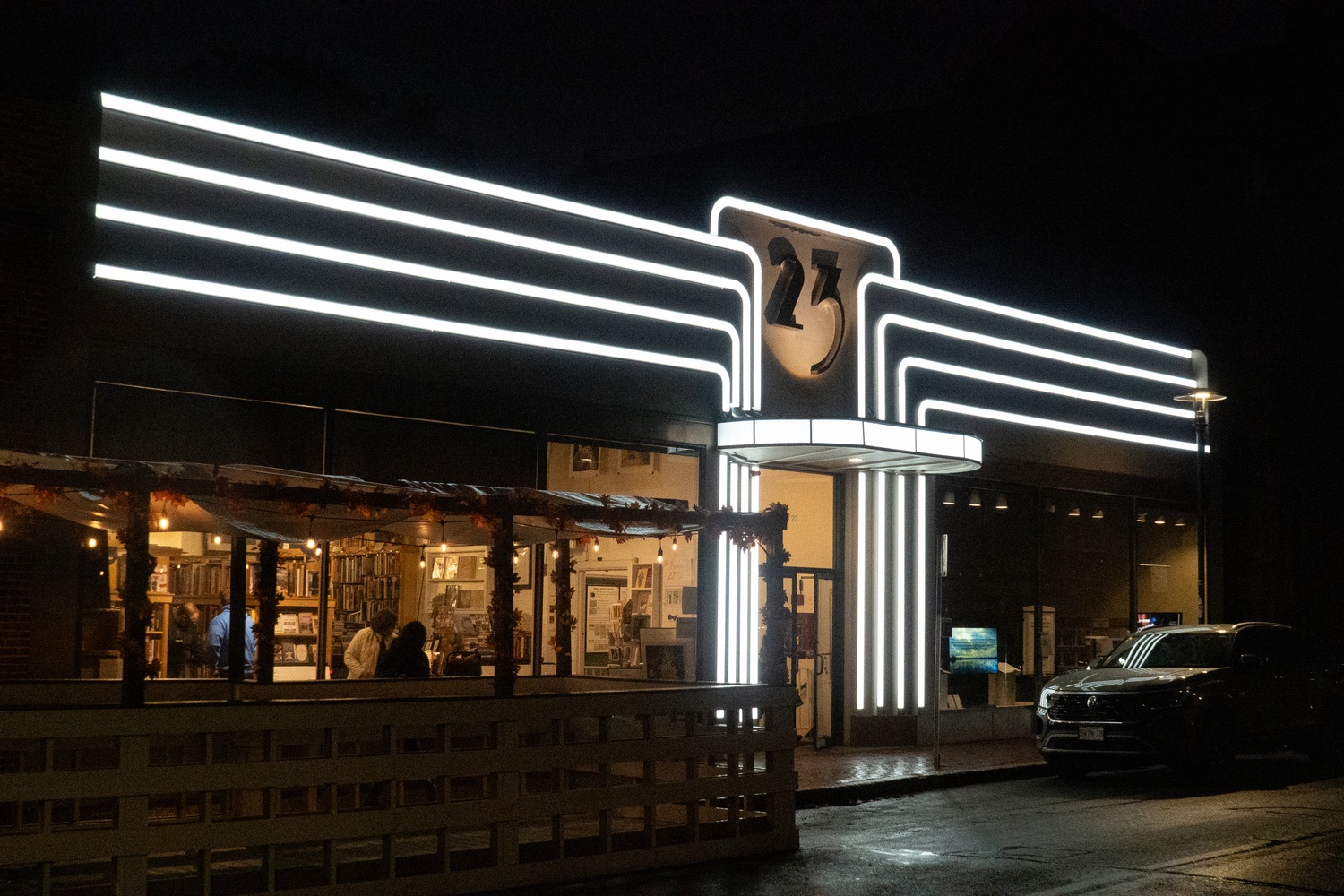
A burst of brightness came to a gloomy stretch of Church Street last month as the Christian Science Reading Room restored soft white art deco lighting absent from the building’s facade for decades.

The lights returned to Church Street, across from the long-dormant AMC Loews Harvard Square, at a Nov. 7 unveiling. Pictures of the alluring illumination have become a slow-trending wave on local social media.

“Now when you see it, it catches your eye,” said Jason Fredette of Poyant Signs, the New Bedford company that restored the lighting over nine months. “The building looks totally different.”

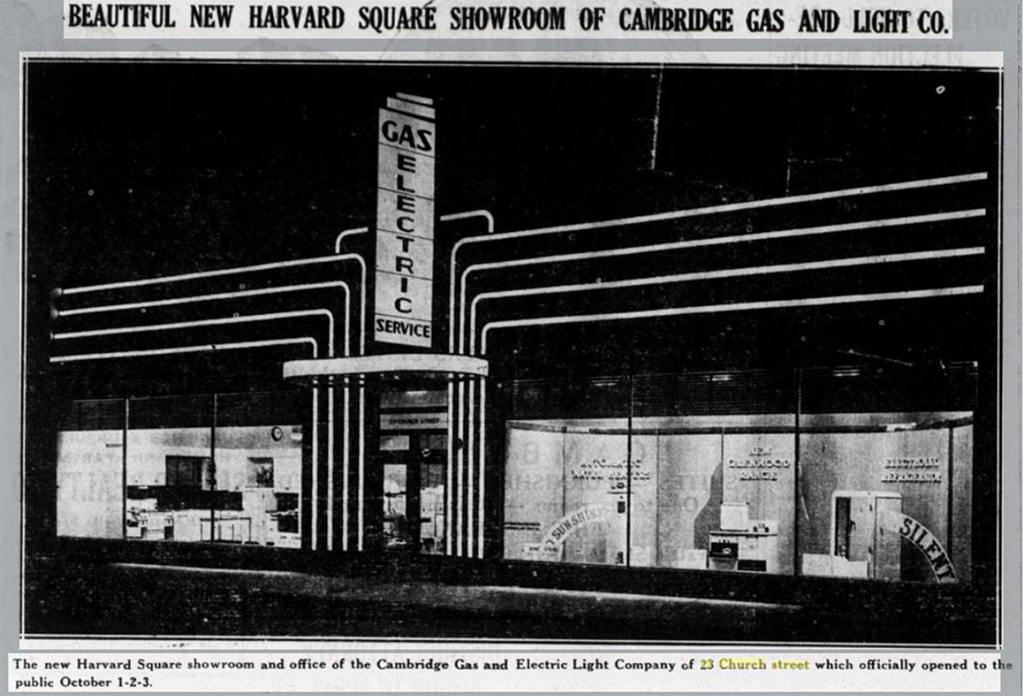
The first structure at the site was a blacksmith shop in the late 1800s, later a veterinary practice. That became mixed retail at the turn of the century as Harvard Square became more thickly settled and the subway arrived in 1912, said Cambridge Historical Commission executive director Charles Sullivan. The 23 Church St. structure was razed in favor of the current one-story 1936 art deco design by architect William Laurence Galvin as a new, upscale home for Cambridge Gas and Electric Light Co.

Historical CommissionA newspaper account of the 1936 opening of the Cambridge Gas and Electric Light Co. building in Harvard Square.

Galvin’s design was fitting; the company used the space primarily as a showroom for displaying the latest in energy-related technology such as automatic ranges and hot water heaters, as well as for educational exhibits. The illumination of its curving facade required hundreds of 15-inch incandescent tube lights, each lasting only around 1,500 hours and requiring frequent maintenance. “You were getting up there and two or three of them would be dead,” reading room manager Elliott Reinert said. “They were probably constantly doing it. But they were the electric company.”

The First Church of Christ, Scientist, Cambridge, bought the site in 1947 for a reading room. The other half of the building has always been designated for retail by church management and is occupied by Rodney’s Bookstore.

When the lights disappeared is unclear. Cambridge Gas and Light, now part of Eversource, gave documents to the historical commission in the late 1980s or early 1990s, but it wasn’t until long after that Sullivan reviewed the architectural designs for the building and discovered they included the long-gone lights.

One could deduce the lights went dark and disappeared sometime before the 1947 sale to the church, possibly the result of blackouts during World War II meant to prevent buildings from being targeted for Axis attacks, Sullivan said.

The restoration began with Sullivan’s discovery and was made possible by a preservation grant from the commission, contributions by members of the local church and with effort by Reinert. Securing the funds was easy compared with the work of finding a company to bring the era’s aesthetic back to life.

It was a long process – more than two years of calling more than 50 companies all over the United States, Canada and China, Reinert said. After a first frustrating phase “waiting for the technology to catch up,” Reinert looked up one day in a mall parking lot and literally saw a sign: It was made of molded LEDs, and it was what he knew 23 Church St. needed.

“I finally had the vocabulary. Once I understood what I wanted, it was a matter of finding somebody that was willing to do it – beyond that, it was finding somebody who was really excited about doing it,” Reinert said.

Many of the industrial lighting companies he contacted were not. But one of his calls led him to Poyant in New Bedford. “They wanted be part of art and history,” Reinert said. “Their expertise and enthusiasm was perfect.”

The lighting was part of a bigger restoration of the building that included masonry, roof work and removal of red awnings that had long obfuscated the signature grooves for the incandescent tubes – now filled with modern technology using minimal energy and expected to last years, if not decades.

“We are delighted with the lights and truly appreciative of all the effort and the outcome,” said Denise Jillson, executive director of the Harvard Square Business Association.

Print
Boston Globe

In Harvard Square, Muji takes over major storefront

By Dana Gerber Globe Staff,Updated December 4, 2025

Inside Muji's new location in Harvard Square.
Inside Muji’s new location in Harvard Square.MUJI & Joel Benjamin

In January, when Anthropologie closed up shop in Harvard Square’s historic Design Research building, questions swirled about what would replace it.

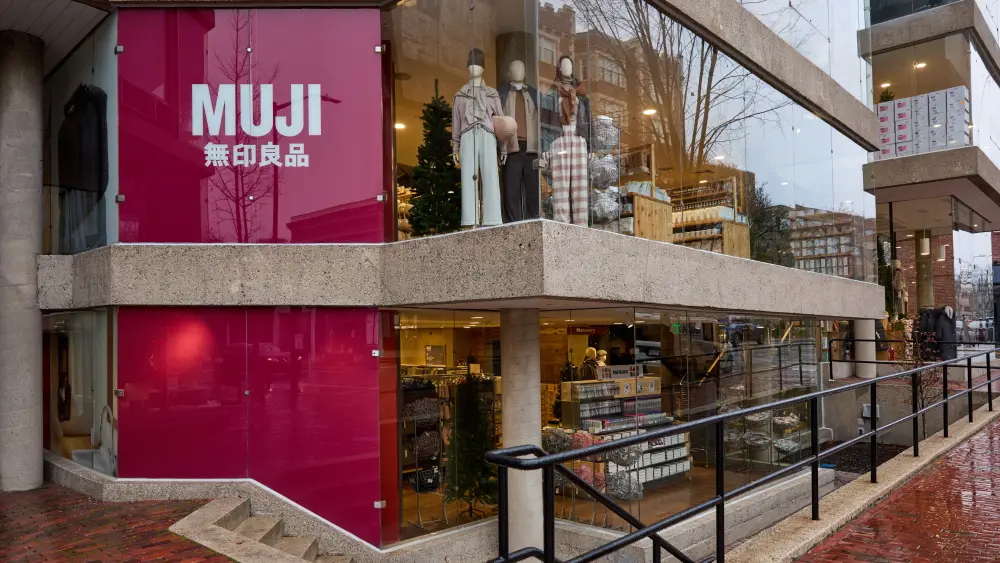
It didn’t take long for Cantabrigians to get their answer: Muji, a Japan-born lifestyle retailer, opened on the well-trafficked Brattle Street stretch in late November, offering its wide-ranging array of stationery, clothing, food, and home goods.

“Harvard Square’s creative, diverse, and community-driven atmosphere aligns perfectly with Muji’s philosophy,” said Richard Rappaport, president of Muji USA, in a statement.

Nestled next to the new romance bookstore Lovestruck Books, Muji’s Harvard Square location spans nearly 11,500-square-feet across multiple floors. The meticulously organized shelves hold an eclectic selection: color-coded gel ink ballpoint pens ($1.90 each), yuzu fruit spread ($8.90), lacquered chopsticks ($9.90), rice cookers ($149), and aroma diffusers ($79 for a regular size, $129 for a large) emitting sweet scents like grapefruit and lime. There is also bedding, luggage, cleaning supplies, mens and women’s apparel, toiletries, and storage containers.

On the top floor, near an array of kitchen supplies, is a “robot barista” named Jarvis — patrons can punch in their beverage order on a tablet and watch as a mechanical arm assembles it.

A selection of food inside Muji's new Harvard Square store.
A selection of food inside Muji’s new Harvard Square store.MUJI & Joel Benjamin
The "robot barista" at Muji's new Harvard Square location.
The “robot barista” at Muji’s new Harvard Square location.MUJI & Joel Benjamin

Rappaport said the company took great care to use the building’s notable glass-walled exterior to their advantage. “We embraced that idea, designing the space so the community can see each level and its offerings from outside,” he said. “That openness aligns perfectly with Muji’s own design philosophy of simplicity, transparency, and integration with everyday life.”

When the building, designed by architect Benjamin Thompson, debuted in 1969, it served as the headquarters for Thompson’s interior design brand, Design Research. Before Anthropologie came along in 2010, the space had long been occupied by an outpost of Crate & Barrel.

Muji recently opened its doors in Harvard Square, in the property often dubbed the Design Research building.
Muji recently opened its doors in Harvard Square, in the property often dubbed the Design Research building.MUJI & Joel Benjamin

“It’s such an iconic building and a beloved space in Harvard Square,” said Denise Jillson, executive director of the Harvard Square Business Association, which she said Muji has already joined. (Muji also has a location on Newbury Street.)

“They reached out almost immediately,” she said, “saying how much they wanted to be part of the community.”

48 Brattle St., Cambridge; muji.us.

Print
Women's Wear Daily

Muji Opens Twelfth Store in the U.S. in Harvard Square

The location has a rich design heritage that is tied to what was known as “Cambridge Modern.”

By Rosemary Feitelberg

November 25, 2025, 3:39pm

For its latest store opening, Muji has debuted in the heart of Harvard Square in Cambridge, Mass.

Located at 48 Brattle Street, the outpost’s nearby neighbors include Patagonia, Marine Layer, Miniso, L.A. Burdick Handmade Chocolates and two women’s clothing stores, Tess and Mint Julep. With nearly 11,500 square feet of space over a few floors, Muji shoppers should have plenty of elbow room to check out the apparel, accessories, home wares, gifts and other items that the Japanese lifestyle brand is serving up.

This marks the retailer’s 12th store Stateside and its second location in the Boston area. With a little more than 900,000 square feet of retail space, Harvard Square is a popular pedestrian-friendly shopping area especially with college students and traffic from Harvard University. Representing more than 350 years of growth and change, Harvard Square houses a mix of cafés, stores, restaurants, housing and institutions including many long-standing independent businesses.

Operating more than 1,300 stores internationally, Muji is always looking for cities to expand into, according to a company spokesperson. The company is reportedly planning openings in Bangkok, Ho Chi Minh City and Paris.

The Brattle Street location has a deep design heritage. After World War II, Harvard Square was the nucleus of the design world, thanks largely to the Harvard Graduate School of Design, where architects who were fleeing Europe gravitated and shared their modernist ideas with students. The presence and work of Walter Gropius, Marcel Breuer and Le Corbusier helped to create what was known as “Cambridge Modern.”  

The architect and Harvard Graduate School of Design faculty member Benjamin Thompson helped to solidify that by starting the interior design shop Design Research, which was known as “D/R” in 1953. For the opening of the company’s headquarters in 1969, Thompson created frameless glass walls as a way to connect use the building’s interior to enliven the streets. The former D/R headquarters now house the Muji store.

Its expansive facade means that passersby can get a good look at Muji’s wide range of merchandise and the well-designed space. Conversely, shoppers can get a sense for the street life and what’s happening outdoors.

Muji USA president Richard Rappaport said, “Harvard Square has long been a hub of culture, creativity and connection and we are thrilled to bring Muji into this community.”

The three-level space offers Muji’s stationery, travel accessories, luggage and men’s apparel and accessories on the ground floor. Women’s apparel and accessories, as well as health and beauty products are available on the first floor.

Shoppers keen on organizing will find cleaning and storage solutions, homeware, small furniture, bedding, kitchenware (including the relaunched Rice Cooker) and food products on the second floor.

The Harvard Square location carries the recently launched Booster Series Skincare and repackaged Sensitive Skincare Series that is a popular seller in Japan. As part of Muji’s ongoing global effort to connect with local communities, Muji Harvard Square has Jarvis the Robot Barista, an automated coffee service that serves beverages for customers to enjoy as they explore the store. To try to encourage the academic community to share books, the Little Free Library is on-site, too. Denim recycling is also welcome via the Blue Jeans Go Green program that is in partnership with Cotton Inc.

Muji recently celebrated another milestone — the 10-year anniversary of its Fifth Avenue store in New York City. Unsuspecting shoppers joined in on the festivities Thursday night when they lined up for a slice of the anniversary cake from Nazli & Co. Like its competitors, Muji is gearing up for Black Friday and Cyber Monday shoppers with special offers for items as diverse as flannel tops and cacao truffles.

Print
Cambridge Day

Harvard Square’s Red House is being replaced by something historic but new: a club for Cambridge

By Marc Levy

Saturday, November 15, 2025

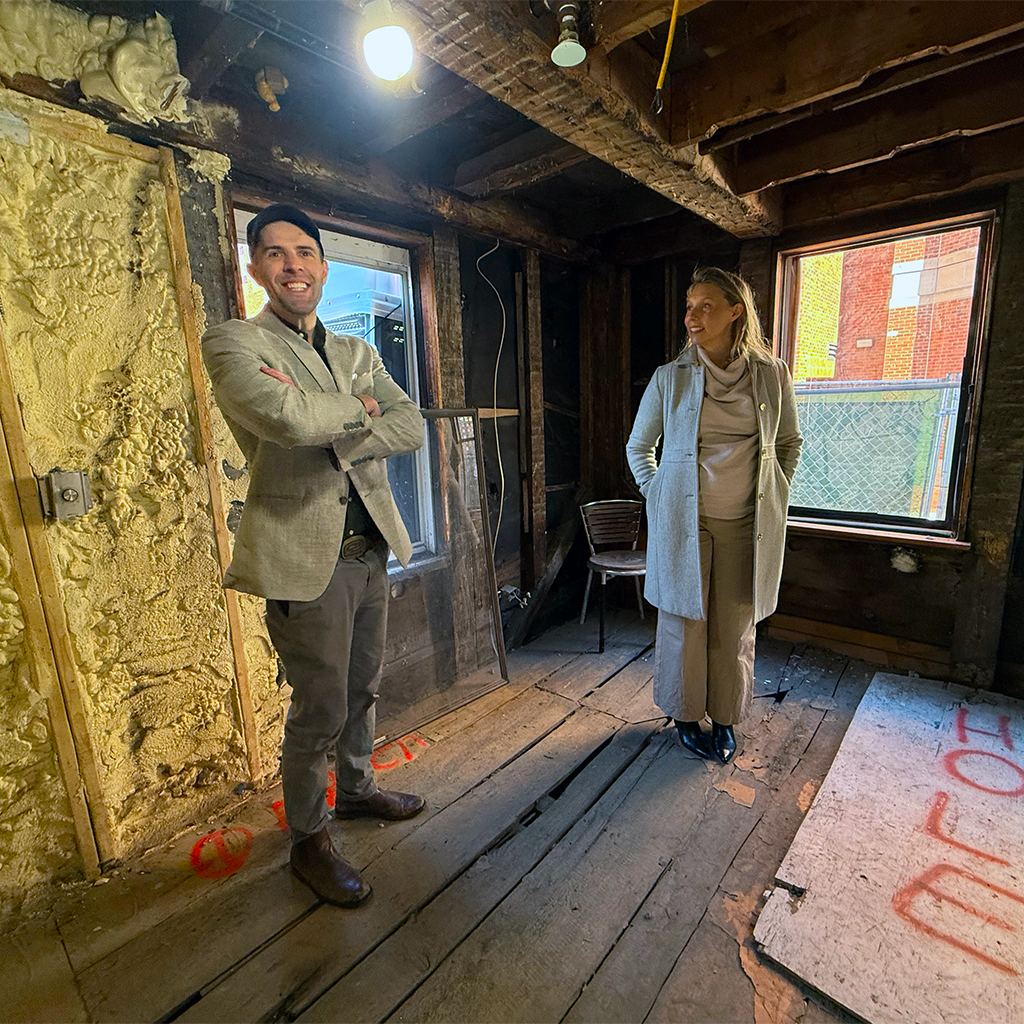
Marc LevyRyan and Molly Lindbergh inside a gutted 98 Winthrop St. in Cambridge – the former Red House and future Cox Hicks Club – on Oct. 16.

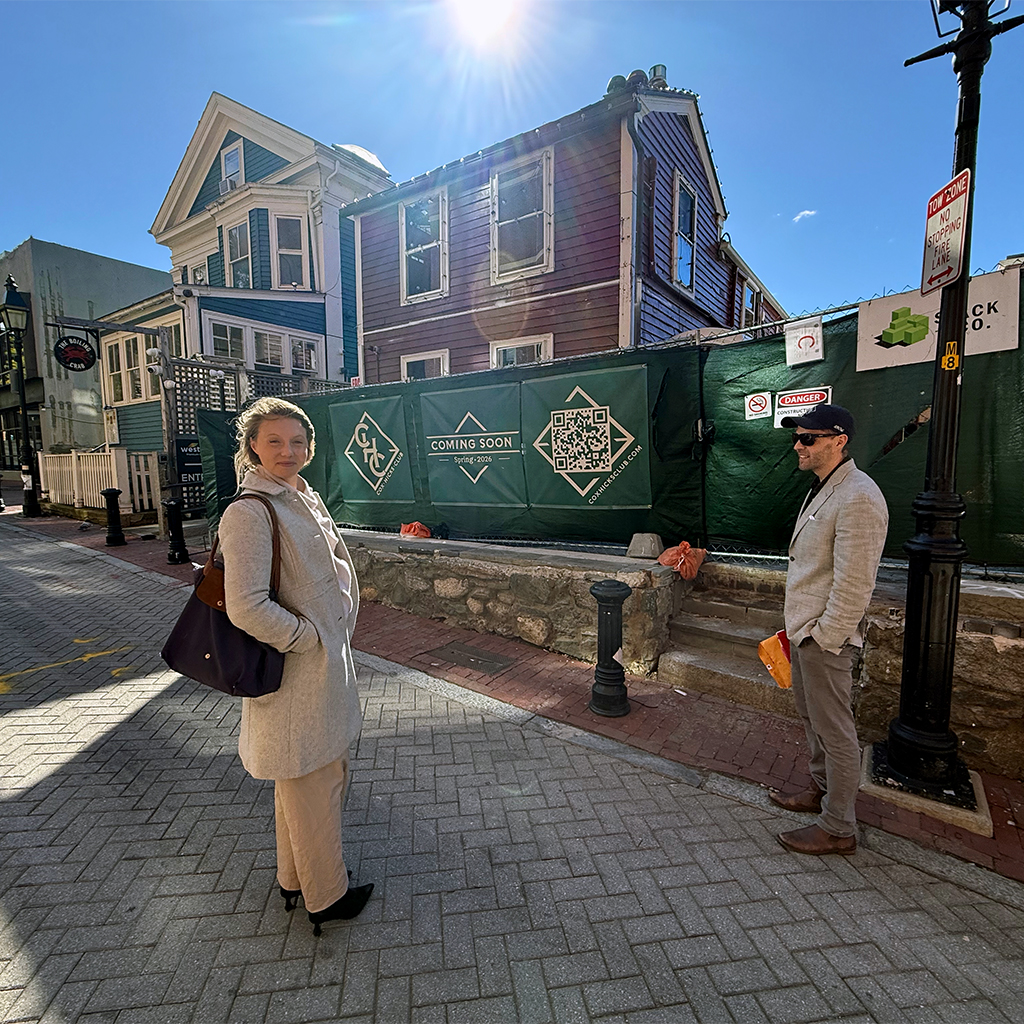
What was known as The Red House at 98 Winthrop St., famed for its lobster menu and cheerfully blazing fireplaces, has been carefully gutted, stripped to rough floorboards and eccentric angles from centuries past to become an entirely new concept in the spring. Owners Molly and Ryan Lindbergh – Molly is the daughter of Red House founder Paul Overgaag – are at once bursting to talk about it and reluctant to reveal too much.

“We’re paring it back to the original inception of hospitality, to classic styles that are local to New England,” Ryan Lindbergh said during a walkthrough of the space in October. Less lobster, though a bisque and clam chowder can be expected; beef from Tendercrop in Newburyport, which raises its own cattle; likely some hearty ravioli; perhaps a dish that pays homage to The Red House.

“We want to to give people a fine dining experience, but you can go to it and not feel like, ‘What just happened to my wallet,’” Molly Lindbergh said.

More than anything, they want the Cox Hicks Club to be a clubhouse in more than name – one open to anyone. “As someone who grew up here and lives here,” Molly said, “Where is the character? Where is the soul? I want it back. I want this to be the cornerstone, the heartbeat. I want people to love it. I want people to be proud of it as part of this community. And I’m not talking about people visiting; I’m talking about people who live here all year.”

The couple has been obsessing over the house and its future for five years, as they emerged from Covid in steps, building from a sidewalk lobster stand into a frenetic peak in 2023 and sagging into last year as tourism dipped, economic uncertainty set in and the couple found themselves “Band-Aiding a lot of problems,” Molly said, with a building parts of which are well over 200 years old.

Marc LevyThe Lindberghs have been thinking about The Cox Hicks Club for five years.

They shut the Red House forever in October 2024, on the last day of the Head of the Charles regatta. With Needham Bank, they are betting big on a thorough refurbishment that has Ryan prowling salvage yards for granite, hand-hewn wood beams and the gas lanterns he plans to install along Winthrop Street.

The Lindberghs’ goal of a sustainable kitchen drew a $100,000 grant from the city, which led to the shock discovery that the historic Red House was the only structure on the street without direct access to power lines, and The Cox Hicks Club kitchen couldn’t support the new equipment. “We need the electrical capacities to be future looking,” Ryan said, to someday be independent of fossil fuels. “We’re putting so much energy upfront into the utilities and the unsexy parts of doing this project. Our general contractor looks at us and is like, ‘Does this make economic sense?’ No, no, but we’ve got to do it.”

An October rendering of the future Cox Hicks Club, which was designed by Ryan Lindbergh.

Their rebuilding for the ages is in consultation with Charles Sullivan, of the Cambridge Historical Commission. With its earliest parts dating as far back as 1796, Sullivan said, 98 Winthrop is only Federalist-era house in the city on its original site and original foundation. It sits atop a stone retaining wall built as part of a scheme to develop the town’s brook into a wharf, Sullivan said in a call. That idea, to dredge the brook and bring in cargo by barge and schooner, didn’t work out, but the house served its purpose: sheltering Sarah Hicks, the widow of John Hicks, a Tea Party participant who died at the battle of Lexington and Concord.

“It remains an almost unique example of the type of very modest, single-family house that would have been occupied by a person of limited means,” Sullivan said.

A later owner was Susannah Cox, a widow who welcomed other widows as tenants. The structure stayed a home into the 1970s, when the last resident willed it to Harvard. After using it as office space, the school sold the property to Overgaag in 1998 for conversion into a restaurant. He built everything back from the main dining room in 2001 and opened the Red House – the structure has been painted red since the 1890s – a couple of years later. 

Marc LevyThe Lindberghs on Winthrop Street outside the Cox Hicks Club, which they hope to open March 1.

“I’ve had a love-hate relationship with this house,” said Molly, recalling one of her chores as a child growing up in a restaurant: sweeping up cigarette butts on Winthrop Street. “I’ve learned to love it. I’ve learned to also love working with Charles. I’m like, you know what? I get it. Like, I get why this is important.”

The Lindberghs have put up a whole website on the history as well as prepared a custom historical marker for the house, aghast that it was skipped when the blue ovals went up around the bicentennial. (“I’m not sure why it wasn’t in the original lineup of markers,” Sullivan said.)

The Lindberghs are making their own addition – upward, so the club will wind up seating the same roughly 100 people as The Red House, but without crowding. The roof is getting a deck with a bar, including a three-season patio with its own fireplace. Dining is focused on the second floor, leaving the ground level with a series of unique spaces for dining and lingering that feel like they’re for “the people who live here year-round,” Molly said. The Lindberghs are setting up a chess table directly in front of a fireplace. “The conversations in this town. People writing books. It’s insane, the amount of knowledge being transferred. I want this floor to enable people to do that and feel like the original inception of a restaurant, as a meeting house.”

The fireplaces won’t be the same – the logs are impractical and bring rodent problems, Ryan said. They will be converted to burn pellets that provide the same cheery blaze and warmth. And every booth will get a view.

“It should create just a really beautiful sense of nostalgia when you’re sitting and having what should be very fine dining service,” Ryan said. “It should button everything together.”

More about The Cox Hicks Club:

Molly is excited about Christmas at The Cox Hicks Club. “I cannot wait to have a massive Christmas tree out on my deck,” she said, and to hire carolers to delight people strolling and shopping. Electrical outlets have been added to the deck specifically to light the tree. “Just because, like, why not? No one does it anymore. It makes me happy,” she said.

The Cox Hicks Club may go tipless to combat dining-out “exhaustion.” The couple dislikes when a meal ends feeling like doing complex math. “Between a price on a menu and the end price you see on a receipt with a 20 percent tip, with a kitchen admin fee, sales tax, meals tax, and it’s just like, it’s not what you see is what you get,” Ryan said. “We have the ambition to try to pare that down and eliminate as many of the painful touch points as possible.” The hope is to get staff on salaries with health insurance and make it “an actual sustainable place to be.”

Don’t expect a big online presence for this throwback club. There will be no social media for this restaurant, Molly said. “I’m not doing it. It’s not what we’re about,” she said. She’s not even sure she wants to post the menu online. “I just want people to come in here and the server to tell them everything and tailor it to the table. I want to be, like, welcome to the experience, my friends.”

The club has a tentative opening date of March 1.

Print
WCVB

Wednesday, Nov. 19: What’s New?

It’s another round of what’s fun, informative, entertaining – and new!

Updated: 8:10 PM EST Nov 14, 2025

 Editorial Standards ⓘ

It’s another round of what’s fun, informative, entertaining – and new! Shayna Seymour visits a Boston café that is fulfilling patrons’ wishes, while a Newbury Street shop helps shoppers make their design dreams come true. We sample the fare at a new North End restaurant and a Harvard Square hot spot; explore a new suburban children’s museum; and tour a revolutionary exhibit at the Boston Public Library. Shayna brings it all to us live from MarketStreet Lynnfield, which is gearing up for winter fun.

Print
Harvard Independent

Veritas and Vulnerability: Sexual Wellness in the Square

Sidney Regelbrugge

11.13.25: The Sex IssueNews

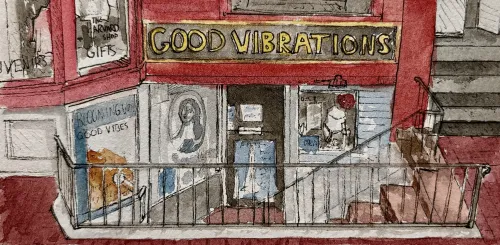
Deep in Harvard Square, amidst the many coffee shops, bagel stops, and bookstores, stands “Good Vibrations,” a nationally known chain of sex-toy stores. Less than a mile apart from Good Vibrations is Hubba Hubba, another renowned BDSM-centric business. For some Harvard College students, these sexual wellness stores serve as an essential resource for exploring intimacy and alternative romantic practices. With Hubba Hubba permanently closing on Nov. 24, Good Vibrations is set to be the Square’s last-standing hub for such practices in proximity to University affiliates.

Located at 52 John F. Kennedy St., Good Vibrations, a storefront for the “Good Vibes” corporation founded in 1977 and based in San Francisco, offers an array of products both online and in-store.

Their website’s anthem speaks to their ethos and product line: “In our world, pleasure is celebrated. Shame is erased in favor of empowerment. WHY? is replaced with HOW? Or maybe, HOW OFTEN? Curiosity is revered and encouraged. Information is openly shared. And sex, in every form, can be nothing short of extraordinary. This is the world of Good Vibes. COME JOIN US HERE. WE’LL BE YOUR GUIDE.”

Good Vibrations’s approach to sex toys focuses on rewriting the current shame-saturated narrative, emphasizing that their storefront is a woman-friendly place to shop. The inventory includes vibrators, dildos, lube, penis toys, anal toys, BDSM fetish, harnesses, lingerie, and more. Prices range from $5 to over $150, with the cheapest item being “Poppin’ Rock Candy Oral Sex Candy,” priced at $2. Some higher-end products can cost more than $1,000 and are designed for advanced or specialized use, such as “The Dicktator—Extreme Sex Machine.”

Before Good Vibrations’s establishment in January of 2017, Hubba Hubba was the sole sex store serving the Cambridge community. To Hubba Hubba’s owners, employees, and customers, it was more than a facility to purchase intimacy products; it was a place of education and open-heartedness. What started as an underground, alternative, and woman-owned fashion store in 1978 has transformed into the sex-positive alternative store that it is today. 

“Hubba Hubba is: a health education center, salon, art gallery; as well as a place to restart, meditate, dance, meet a date, learn, and become politically active,” the business’s website reads.

However, due to rising expenses, landlord tensions, environmental changes, and a fluctuating economy, the community that Hubba Hubba hoped to amplify is now in jeopardy, and the business is shuttering in two weeks. 

Neither Good Vibrations nor Hubba Hubba were available for comment on the impact of their stores on the Cambridge community. Hubba Hubba expressed having faced past controversies with the Harvard community to the Independent, though further details were not shared. Similar to Hubba Hubba, BDSM-oriented stores and communities often contend with comparable misconceptions and misunderstandings. 

In an article written by Dr. Namita Chaen—a clinical sexologist, certified sex, intimacy & relationship coach, and certified sexological bodyworker—Chaen addresses the common misconception that BDSM practices are abusive and purely about pain. She challenges this viewpoint by explaining that it is a very consensual and individualized practice for all participants. 

“At the heart of BDSM lies the interplay of dominance and submission, where individuals willingly engage in power exchange dynamics for mutual pleasure and fulfillment,” she explains. “Dominance involves asserting control over a partner, guiding and directing their actions within agreed-upon boundaries. Submission entails surrendering control and entrusting oneself to the dominant partner’s guidance and authority.”

While BDSM culture has been more accepted in mainstream media in recent years, typically conservative viewpoints regarding sexual practices seem to have become more common among young adults. 

“In the last one or two years, I have noticed more people subscribing to purity culture—I hear more about people talking about having a low body count or waiting for certain relationship milestones than I used to,” an anonymous senior in Winthrop House shared in a statement to the Independent. Despite the Hubba Hubba and Good Vibrations’ struggles, Harvard College undergraduates spoke to the growing trend in demystifying sex in anonymous public forums. “I think in a broader long-term sense, there has been an attitude toward sex positivity over the years; however, shame/purity culture definitely renews itself in waves, and recently there has been a return to conservative attitudes in the last year or so,” a senior in Currier House said.

However, conversations regarding sex, intimacy, and sexual wellness on campus are still viewed as too taboo for open dialogue, delegating such conversations to smaller, personal groups.“Me and my friends I love talking about sex. That being said, I think Americans are more squeamish about talking about sex than certain other cultures (e.g., Europeans),” G.B. ’27 wrote to the Independent

That same hesitation surrounding open dialogue about sex appears to carry over into students’ real-world behaviors, with the majority of interviewees expressing uncertainty or reluctance about visiting sex stores, including Hubba Hubba and Good Vibrations.

A sophomore in Adams House disclosed that they had been to a sex store in the Square, but did not specify which one, and clarified their visit was not by choice. “[It was] for an initiation task, not of my own volition,” the student said. 

In addition to having mixed answers to visiting sex stores in the Square, there was also a sense of uncertainty about the educational purpose of sex stores. “I don’t know if [sex stores] actually affect anything, but rather just have people walk by and giggle,” the sophomore continued. “I think a productive conversation is induced by two people, not just the presence of the store.”

G.B. shared a similar sentiment. “I think they are [a good way to spread awareness about sexuality]. But since it requires people to buy things, I don’t think it’s accessible to everyone.”

In Harvard Square, sex stores occupy a small but visible share of local businesses. Such visibility has sparked conversation about whether the culture they promote will gain more traction in the future. 

“Even though I’ve never been to one myself, seeing the signs around the square definitely opened my mind more to the possibility,” the Winthrop senior said. “I’ve also heard friends talking about things they’ve seen or bought at sex stores, which could increase sex positivity, although that is more included in just talking to people more openly about sex.”

Others disagreed, explaining that the sex stores in the Square did place sexual wellness in plain sight; however, that was not quite enough. “I don’t think their existence alone pushes for a sex-positive mindset in the average person due to the general sentiment that hovers around them,” the senior in Currier House said.

Both store owners and Harvard students agree that honest discourse about wellness and intimacy is highly important to create a truly sex-positive environment. 

Good Vibrations offers multiple how-to blog guides for people to begin exploring self-induced pleasure and sex toys, both for couples and individually. 

The Currier House student emphasized that sexuality should be something that everyone feels comfortable exploring. 

“My philosophy is that everyone should feel comfortable exploring their sexuality however they see fit as long as it is done in a manner that is respectful to any other parties involved,” they explained. “Sex is a pretty inherent part of human culture, and I think perpetuating a level of shame or negativity around it creates unnecessary harm.”

With Hubba Hubba closing and Good Vibrations remaining the last sexual-wellness shop in the Square, the conversation regarding sexual wellness and sex positivity seems to be one that will continue, regardless of students’ interactions with these stores. And while Hubba Hubba still has its doors open, students and community members can stop by and explore its diverse products, with all products in the store being 25% off. 

Sidney Regelbrugge ’28 (sidneyregelbrugge@college.harvard.edu) hopes that dialogue about intimacy continues across campus.

Print
The Crimson

23 Church St. Lights Up After Restoration of Historic Light Fixtures

Historic lighting was restored to the exterior of 23 Church St. in November 2025.

Historic lighting was restored to the exterior of 23 Church St. in November 2025. By E. Matteo Diaz

By Jaya N. Karamcheti and Kevin Zhong, Crimson Staff Writers

Yesterday

After nearly 80 years in the dark, 23 Church St. lit up Friday following the restoration of historic lights on the exterior of the Art Deco-style building.

Around two dozen residents gathered on Friday night to watch the debut of the lights, which were originally installed in 1936 after the Cambridge Gas and Electric Light Company purchased and developed the property for its showroom and office. The lights outlined the perimeter of the storefront, illuminating a display of kitchen and electrical appliances.

Sold to the First Church of Christ, Scientist, in 1947, the building currently houses the church’s Christian Science Reading Room and Rodney’s Bookstore. According to Charles M. Sullivan, executive director of the Cambridge Historical Commission, the lights went out sometime around the mid-century transfer and remained that way until Friday.

While working on a book in 2015 about historical architecture and development in Cambridge, Sullivan came across photos of the outside and inside of the Church Street property and noticed the light installation. Seeing the photos sparked a plan to restore these historical lights in the modern day.

“Wouldn’t that be great someday to restore the lighting?” Sullivan recalled thinking.

Sullivan then approached R. Elliott Reinert, the manager of the Church Street building, about the prospect of bringing the lights back to life. In 2022, with the building needing maintenance repairs, Reinert thought the time was ripe for a lighting restoration.

“When I saw how the building had been architecturally designed and to have these strips of light that really complete the building, either by day or night, it was sort of a dream,” Reinert said.

“I never thought we’d really be able to do it, but it seemed important to me because of beautifying the neighborhood,” he added.

Sullivan said that finding a company to take on the task of restoration was difficult due to the challenges of working with old technology.

Print
The Crimson

The Harvard Square “KiOSK” is a Waste of Space — and $12.6 Million

By Ollie F. Ginnis

By Kate E. Ravenscroft, Crimson Opinion Writer

Kate E. Ravenscroft ’26, a Crimson Editorial comper, is an English concentrator in Cabot House.

6 hours ago

The Harvard Square traversed by Julia Child, Bill Gates, and decades of Cambridge residents and students, is increasingly different from that which exists today. Amid the changes, one iconic, lamp-lit newsstand had long stood above Cambridge, reading “Out of Town” — a cultural landmark that presided over the Square as a news outlet from 1954 to 2019.

This year, that storied newsstand was officially replaced by the Cambridge KiOSK, touted as a “vibrant public space in the heart of Harvard Square, offering free programming, information, and a dynamic gathering place for all” — a reimagined “community space for the 21st century” — whatever that means. One look at this thing confirms that the old, eclectic Harvard Square has been strangled by the virulent spread of millennial gentrification once and for all.

The first time I toured the College as a high school junior, the once-beloved newsstand was already under construction — Out of Town News sold its last magazine on Oct. 31, 2019, over two years before my visit. By the time I started college, it appeared as though zero progress had been made on the obtrusive construction site.

As I passed the ugly, unperturbed corpse of what used to be Out of Town News nearly every day for the next three years, I naïvely assumed the structure was undergoing renovation. I dreamed of the day I — like the leagues of Harvard students and locals before me — might stroll up to the charming newsstand to buy that rare Italian Vogue, a pack of Marlboro Golds, and some mint gum.

My hope that the refurbishment would finally conclude before my high school graduation peaked last spring when, for the first time in four years, I actually saw construction workers on-site. However, when I approached the still largely unfinished Harvard Square intersection last May, I was instead greeted by the new-and-unimproved, sterilized Cambridge KiOSK.

I pass the KiOSK at least twice every weekday on my way to and from class. I have never seen a single visitor inside. The building is often instead occupied by a lone employee with little to do. It is no longer decorated with niche magazine covers, but by lukewarm, minimalist political installations that espouse the unflattering aesthetic of Instagram social justice infographics.

The chronic vacancy of this allegedly lively community center makes me wonder: Who asked for this? While the KiOSK claims to fill a cultural void, articles on the topic show that Out of Town News was greatly effective in fostering public connection, even well past its heyday. At its closing, numerous outlets quoted residents and employees attesting to Out of Town’s landmark significance and utility — past students, professors, and public figures alike heralded not only its diversity of publications, but its convenience.

The decision to exchange Out of Town News for the modern-day KiOSK seems to have arisen neither from necessity nor the previous tenant’s wishes. Though city staff reported that the owners of Out of Town News declined to extend their lease in 2019, the city had already pitched a $4.5 million redesign of Harvard Square Plaza as early as 2017. The company was informed they would have to vacate the kiosk because it would become a visitor information center.

The rise of digital media and slowing print sales may explain why Out of Town News bowed out of business, but these factors hardly justify the creation of the KiOSK — part of a project that turned the heart of Cambridge into an eyesore for five years and ultimately cost $12.6 million. The result? A plaza that remains unfinished and an empty establishment that appears to serve no one and fuels Harvard Square’s increasingly grotesque tourism industry. Further, the death of Out of Town marks one less locally-owned business in Harvard Square, a once-charming landscape now increasingly saturated with corporate chains.

Going forward, Cambridge city planners and the Harvard Square Business Association might take more seriously their duty to the Harvard community — and the character that once put our intersection on the map — before so easily succumbing to the dollar signs promised by passerby.

To me, the KiOSK represents not a center of thriving public life, but the ghost of Harvard Square’s once-endearing culture — one our city planners have rejected in favor of monoculture, disruptive tourism, and hollow promises of the very community they’ve helped to destroy.