
A crumbling wall in Harvard Square holds centuries of the city’s story, if you know how to read it.
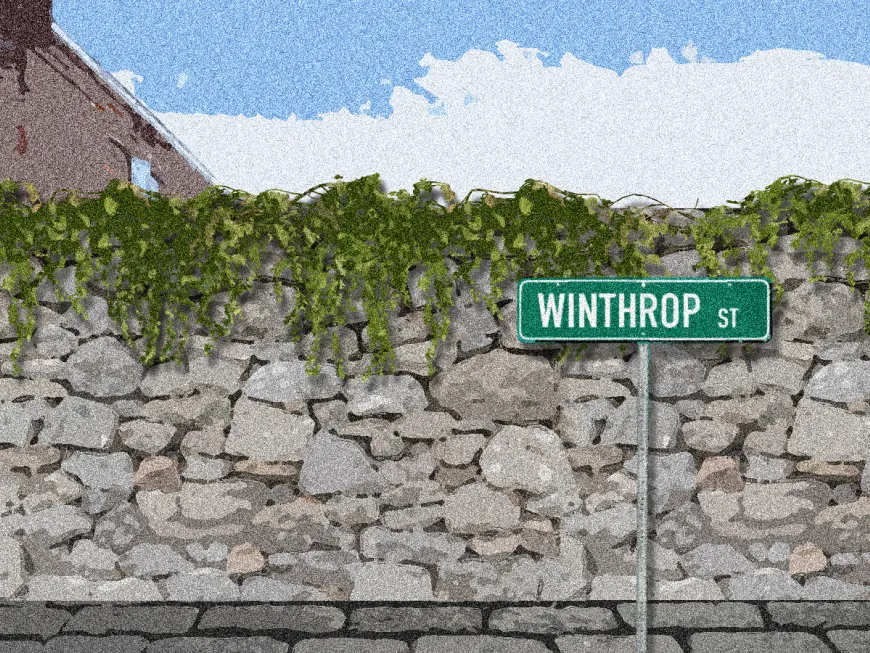
A reimagining of the Old Stone Wall off Winthrop Street in Harvard Square—as it would appear in repaired condition | montage illustration by megan lam / harvard magazine; images by adobe stock
n the winter of 1630, a group of Puritan settlers climbed a low hill above the tidal marshes on the north bank of the Charles River and decided this was the place.
Deputy Governor Thomas Dudley reportedly stuck his cane in the ground in what is now Winthrop Square, a small grassy park adjacent to Peet’s Coffee at 79 John F. Kennedy St, and made it official. They called the settlement “Newtowne.” It would become the first planned town in English-controlled North America, and eventually be named Cambridge.
The site wasn’t chosen by accident. The hill offered elevation: a defensive advantage against pirates raiding from the coast, according to Suzanne Preston Blier, Clowes professor of fine arts and African American history and president of the Harvard Square Neighborhood Association. The settlement’s inland position offered shelter. And just below the hill, a spring-fed brook supplied fresh water.
That brook carved the shape of what we now call Harvard Square. Its path followed what became Eliot Street, then Brattle, then the whole curving grammar of the neighborhood. “Town Creek,” as it was known, ran as a working waterway all the way to the Charles until Memorial Drive buried it in 1900.
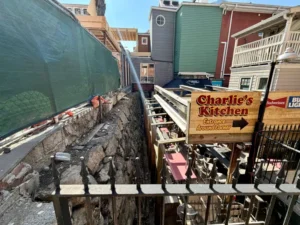
On Winthrop Street, tucked behind Charlie’s Kitchen Beer Garden is the stone wall—mostly hidden from the street—that was built in the nineteenth century to hold the stable high ground of Winthrop Park against the marshy terrain below. Its massive stones are dry-laid, with gaps between them to allow groundwater through to avoid building pressure.
“The wall’s orientation reveals how carefully the city shape was planned,” says Blier, who teaches HAA 170G (“Harvard Square: Social History of Cambridge, MA”), one of the few courses at the College dedicated entirely to the neighborhood’s past and future. She is the author of The Streets of Newtowne, a recently published history of Cambridge told “from the vantage of the streets and pathways and how they experienced the history from the indigenous land holders to today.” She says she could easily write a “story of the city’s history around walls,” too.
Blier means that more literally than it might sound. The original settlement of Newtowne had its own wall (a fence, technically), according to Blier, that every community member was required to maintain to mark the edge of the planned city. The road that once traced the settlement’s outer bounds is now long gone, but the streets adjoining Winthrop Park (JFK, Mount Auburn, Winthrop) are themselves landmarked today for that reason. The grid laid down in 1635 is still in use. To walk those blocks is to follow a plan drawn nearly four centuries ago.
The wall on Winthrop Street is a continuation of this plan…and, unfortunately, it’s crumbling. A section behind the Red House restaurant has already collapsed. Another is visibly falling. Most passersby never know it’s there.
That invisibility is what concerns Denise Jillson, the executive director of the Harvard Square Business Association (HSBA). “I believe the best way to preserve this unique and authentic piece of Cambridge history,” she says, “is by creating community awareness and committing to its importance as a historical relic.” Jillson recently collaborated with Caro Taylor, a Cambridge high schooler and HSBA intern, on a comic book telling the wall’s story. A video by Daniel Berger-Jones, a local historian and member of HSBA, has been making the rounds on social media.
The hope is that more people will peer past the beer garden and notice what’s there. Cambridge has always been better at celebrating its intellectual history than its physical legacy. As Blier puts it: “The wall reminds us that Cambridge’s history is not only celebrated in milestones and institutions but is built into the ground itself—a city that has always found ways to adapt.”
As Cambridge approaches its 400th anniversary in 2030, the wall on Winthrop Street may be one of the last places where a passerby can put their hands on the actual material of the original city.
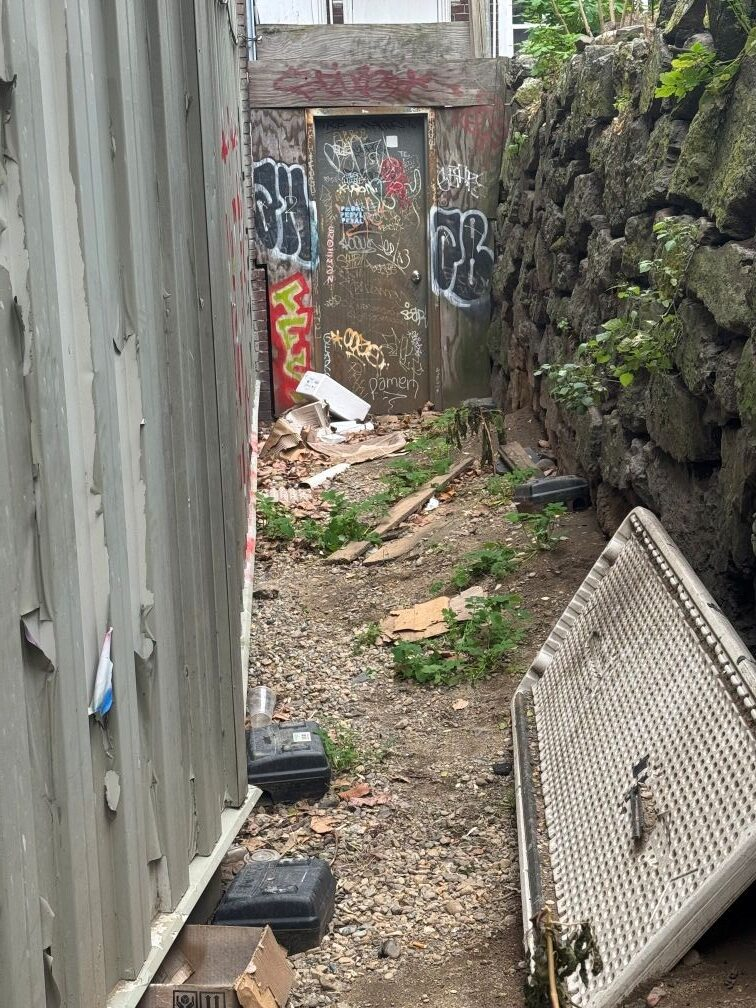
The Old Stone Wall (on the right) is currently crumbling after centuries of neglect | photograph courtesy of harvard square business association
https://www.harvardmagazine.com/harvard-history/harvard-square-stone-wall-history