

Katherine Chung
Graphic by Miranda Chao Hwang
04.16.26: The Weed Issue, News
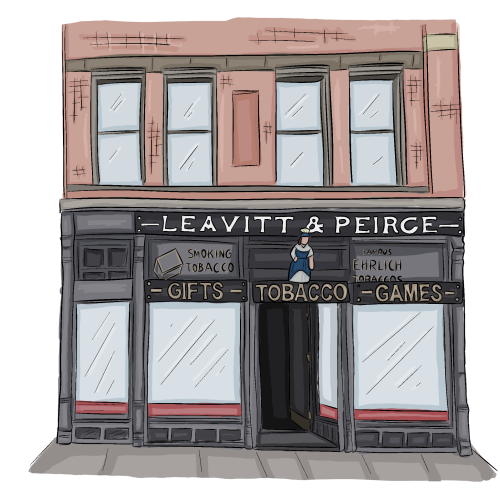
For over a century, Leavitt & Peirce has served Harvard Square patrons on Massachusetts Avenue. Above its entrance, three simple words announce what it sells: gifts, tobacco, games. But inside, there is nothing simple about it. The store is densely packed, stocked with everything from flavored tobacco and pipes to chess sets, Go boards, knives, lighters, Lamy pens, specialty playing cards, and more. Black-and-white tiles line the floor, and the air carries an earthy scent.
Behind the counter, owner Paul Macdonald helps customers as they drift in and out. “Everything we carry here has to fit. If you look around, there’s so many different categories, but it fits,” Macdonald said in an interview with the “Harvard Independent.” “People walk in this store, and they go, ‘Wow, it’s like walking back in time.’”
Leavitt & Peirce was founded in 1883 by Fred Leavitt and Wallace Peirce. “They ran it up until 1920, ’21, ’22, where they sold it to a couple of Harvard grads who thought it would be fun to own a tobacco shop, and then they realized it’s a lot of work,” Macdonald said. “They ran the store for about 30 years until a Boston tobacco shop, Ehrlich’s, bought Leavitt & Peirce. They did not change the name out of respect for the history of the store,” Macdonald continued. “The Ehrlich brothers were Harvard-educated, class of ’26, ’28, so they secretly loved this store more than their Boston store.”
Macdonald turned to his connection with the store. “My father came in the early 1970s to run the business … The stores, I guess, weren’t doing well,” he said.
At 19, Macdonald began working at the Boston store. “In 1983, my father wanted me to come over and manage [the Cambridge] store, so I had to cross the great divide that was the Charles River … it was a culture shock.”
Although Leavitt & Peirce remained a constant for many years, Harvard Square around it underwent significant changes. In the early 2010s, reports noted a shift from a neighborhood-oriented commercial center to a space increasingly shaped by tourism and dining. By 2012, the Square saw an influx of chains and restaurants like Shake Shack, Mike’s Pastry, and Tasty Burger. Local businesses, including the Reading International-owned businesses and Janus Cinema, closed their doors, unable to keep up with the increasing rent. Furthermore, a 2020 report conveyed that rising property values allowed landlords to leave storefronts vacant for long periods of time, holding out for higher-paying tenants such as large chains or banks, contributing to a cycle of empty spaces and escalating rents.
“Harvard Square, today, it doesn’t have the energy, it doesn’t have the funkiness,” Macdonald said. “What’s happened to Harvard Square over the decades is less and less retail shops like us, more and more restaurants. It’s more about eating and drinking than shopping.”
Reflecting on what the Square once felt like, Macdonald pointed to a time when the space was defined less by turnover and convenience, and more by community. “It was just much more foot traffic. We’d have the professors coming in with their pipe tobacco … You’d have hippies still hanging around in Harvard Square coming in for their own tobacco,” he said. “The pit was a gathering place for all kinds of twisted milk and tents … there’d be music there on the weekends … [Harvard Square] was a place where people could feel free.”
In addition to tobacco, Leavitt & Peirce sells games and knick-knacks.“We always specialized in chess. It’s always been a part of the store. I’m sure we’ve diversified over the last few decades just because tobacco was less and less.”
Along with the changes over the years, the rise of cannabis, vaping, and a wide range of chemical-based products has transformed smoking culture. “In the 90s, it was a big cigar thing. It was like a cigar craze, all these young guys coming in,” Macdonald said. “Pipes and pipe smoking—that’s another story. Just for a time, many pipe smokers left. You need a certain temperament, relaxed. ‘I don’t mind cleaning it and scraping it and filling it, and packing it. If it goes out, I’ll relight it,” Macdonald said. “People today—it’s instant gratification. ‘I have to take care of it? I have to learn how to keep it packed?’”
Unlike larger, slower-burning cigars, cigarettes are compact and can be smoked quickly—convenient for those who want quick drags. “Cigarettes are more getting the nicotine. So it’s more of an addiction,” Macdonald added. “You don’t inhale cigars. It’s all about taste, like pipe tobacco.”
According to the National Institute on Drug Abuse, about 23.6 million Americans met the criteria for nicotine dependence in 2025. “The way we sell [tobacco], we sell it as an indulgence, not an addiction. If someone wants a cigar, it’s because they feel like it, it’s not like they have to have it.” Macdonald explained. “People want to know where the tobacco is from. Is it spicy? Is it creamy?”
Tobacco has long been embedded in social life and remains one of the most widely used substances. Cannabis, by contrast, is increasingly legalized at the state level and often viewed as “safer,” yet it still occupies a more ambiguous cultural and legal space. Its use has grown steadily in recent years, particularly among older adults. Following Massachusetts’ marijuana legalization in 2016, a wave of upscale smoke shops, like Blue Moon Smoke Shop, emerged in Cambridge, reflecting a shift toward a more modern, cannabis-oriented smoking culture.
According to Macdonald, Leavitt & Peirce would not consider selling cannabis or adapting to current trends. “It just isn’t in our DNA. You would see the picture of Leavitt and Pierce doing cartwheels on the wall … if we did that,” he said.
The resistance to change, however, exists alongside the realities of running a retail business today, especially in Cambridge. “It’s very hard for a retail store to survive,” Macdonald admitted. “And so we depend more on tourists than we ever did, especially when the school’s out. We need the tourists, and there’ll always be tourists coming to Harvard.”
Still, what sets Leavitt & Peirce apart is not just what it sells, but how it operates. For regulars, the experience is deeply personal. “We know people’s names. We know what they want,” Macdonald said. “Today, you go to the supermarket. There’s one cash register with a checkout person, and there’s five self-serve. You’ll never see that here. It’s one-on-one, always.”
The same philosophy extends to everyone who walks through the door, regardless of status. “We have had the Kennedys. We have had Nobel Prize-winning professors,” Macdonald noted. “We treat everybody like rock stars and royalty.” According to Macdonald, at Leavitt & Peirce, status does not determine service: “a Nobel Prize professor could be third in line, and it could be a homeless person waiting to get a pack of cigarette papers for 75 cents. He’s gonna be taken care of first.”
Some Harvard student organizations have had private arrangements with Leavitt over the years—incentivized by the careful preservation of the business’s products. The store’s cigars are protected in the humidor room, a humidity-controlled space used to store cigars and keep them fresh. Inside, rows of small lockers, each labeled for its owner—some still active, others long gone. “They have keys,” Macdonald said. “Some of these clubs—I don’t even know if they’re in existence anymore.”
“These lockers go back 50 years, 60 years, probably.” Even today, traces of the relationship persist in smaller ways. The Harvard Lampoon, for instance, recently commissioned its own custom blend. “The Lampoon just had a cigar made for their club,” Macdonald said. “One of the companies we deal with said the Lampoon was having a special blended cigar. I guess they had a big fancy dinner.”
Beyond the clubs, the store has long been intertwined with Harvard athletics. “We’ve always had a tight connection with the athletic department,” Macdonald said.
After Harvard-Yale football games, the store would receive the game balls, which are still displayed throughout the space. Hockey sticks from Harvard’s last NCAA championship in 1989 also hang on the wall.
Alongside these artifacts, the store also holds onto more personal connections with the school. Crew coach Harry Parker once stopped by daily. “The crew coach would post the schedule… in our window every morning,” Macdonald said. ”Every morning, he’d come and post a schedule. And then I didn’t see him for a few weeks…in the early ‘90s. And I ran into him on the sidewalk here, and I said, Are you all right, Coach Parker? He says, yes, there’s this thing called email.” The store now honors Harry Parker with a schedule posted in the right-side window.
Katherine Chung ’29 (katherinechung@college.harvard.edu) writes News for the “Harvard Independent.”