After years of struggle, it aims to reinvent itself as a bookstore and something more
For more than a century, the Harvard Cooperative Society, better known as the COOP, was as much part of Harvard Square’s intellectual life as the Cambridge universities that surround it. Harvard and MIT students browsed books and vinyl records for hours, purchased a new suit for a big interview, and rubbed shoulders with the likes of Andy Warhol,

Bette Midler, and even Larry Bird.
But over the years, the COOP withered as the world changed around it. Amazon siphoned sales from bookstores everywhere. Digital course materials replaced textbooks. Harvard Square became more expensive, more corporate, and touristy. When the COOP renovated its flagship store in 2021, longtime customers complained it had been reduced to a souvenir shop, trading stacks of literature for racks of Crimson sweatshirts and lanyards.
Now, a new generation of leaders is trying to make the COOP relevant to a generation that has little reason to visit a bookstore anymore. The organization has ambitious expansion plans, pushing beyond its traditional Harvard Square roots into Kendall Square and Allston, with a new store model built around the kinds of cultural and intellectual experiences that can’t be purchased online.
Its first test case is in Allston, where the COOP recently opened inside the Atlas Hotel on Western Avenue near the Harvard Business School campus.
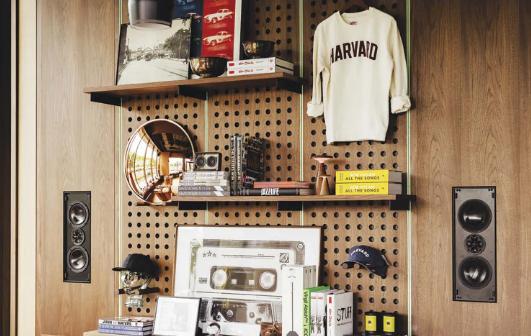
With movable fixtures, curated books and vinyl, products from emerging student startups out of Harvard, and a space designed for author talks, DJ sets, and chef events, executives describe the shop less as a retail store and more like a laboratory for reinventing one of the country’s oldest collegiate retailers.
“It’s a COOP, but it’s the future of COOP,” Jodi Goldstein, its chief executive, said while sitting in the hotel’s lobby.
Goldstein and Adrian Gill, a former Puma executive who is now the COOP’S chief marketing and brand officer, say they’re running the cooperative like a startup, using the new Allston location as a prototype. Instead of measuring success solely by sales per square foot, a traditional assessment for retailers, they want to know how long customers linger, attend events, and see the COOP as a destination again. (The pair declined to provide details of the COOP’S finances, and the universities do not have a financial relationship with the COOP.)
Their premise is one retailers across the country are increasingly confronting: If almost anything can be purchased online, brick-and-mortar stores have to offer something worth the trip.
Jessica Richards, a retail trend forecaster and former executive for Hudson’s Bay Department Store Group in New York, is convinced the COOP can.
“Small, especially known regional department stores have never had a more opportune time to thrive,” said Richards, who suggested the COOP and similar stores should highlight their rich histories. “Retail audiences have never universally wanted the same thing more: nostalgia of when retail looked, felt, and wore better.”
But Todd J. Drowlette, a commercial real estate broker and investor, questioned whether the COOP could really compete with other, bigger retailers if its has a more curated inventory.
“As much as I love nostalgia, it is, for the most part, a thing of the past,” said Drowlette.
Back at the COOP in Allston, Goldstein said they are reimagining all their various retail experiences, wanting to make the COOP indispensable again.
Their flagship store, at 1400 Massachusetts Ave. in Harvard Square, doesn’t only have university-branded apparel anymore. Goldstein said they’ve mixed up their merchandise, as well as launched new studentfocused initiatives, expanded community programming and literary events, creative in-store installations, and collaborations with Harvard- and Mit-founded ventures like Storyfave, an Aipowered storytelling platform, and SXD, a sustainable fashiontech startup.
Around the corner, the COOP owns another four-story building at 12 Palmer St., that it plans to repurpose to host large-scale community gatherings such as supper clubs and moving screenings, include co-working space for emerging entrepreneurs, retail, and more. That’s expected to open sometime in the next year. And in Kendall Square, the team is poised to open a new 12,000-square-foot store in the Google building in early 2027.
Denise Jillson, executive director of the Harvard Square Business Association, said the organization has tried for years to animate Palmer Street, the alley-like way that separates the smaller front shop from the four-story building behind it. The COOP’S vision for the largescale building there, along with the changes at the COOP’S flagship on Massachusetts Avenue, are “transformational for the square,” she said.
In many ways, the COOP’S new leadership team is bringing back part of what once made it one of the country’s great college bookstores.
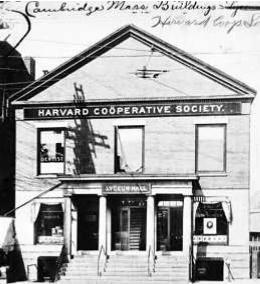
The COOP traces its roots to 1882 when a group of Harvard students believed the university charged too much money for coal and wood to heat their dorms. They pooled their money to purchase supplies in bulk. Then they did the same with textbooks. In 1916, the COOP expanded to MIT, and became a fixture for the communities of both institutions.
It remains a cooperative, owned by its 80,000 or so members, who must be Harvard and MIT students, faculty, or alumni. Membership costs $1 annually and hasn’t increased since its founding.
In 2024, the COOP’S longtime chief executive retired after more than three decades in charge, and the bookstore named Goldstein to take his place. She’s best known for her decade-long tenure leading the Harvard Innovation Labs, an entrepreneurship support program that serves all of Harvard’s schools.
Goldstein acknowledged the COOP from years ago was
“much more meaningful than what it’s been recently.” She’s more diplomatic than others.
In the 1980s and 1990s, Harvard Square was becoming more competitive, and the COOP tried to go up against department stores instead of leaning into what set it apart. A 1994 op-ed in The Harvard Crimson accused the COOP of abandoning its original purpose. Prices were no longer low, student shoppers and membership had declined, books became scarce, and sales were as sad as the “soft, sappy elevator music” coming over the store’s speakers.
As the years went on, Amazon crushed independent booksellers. The rise of online books reduced textbook demands. Then came the pandemic.
The COOP temporarily closed its main store for renovations during the doldrums of 2020 and reopened in the fall of 2021. A few days later, writer Joan Wickersham declared in an op-ed in the Globe that “the renovated COOP is an embarrassment and a travesty,” as the venerable store shrank its stacks of books and expanded apparel and school swag.
For some, the commercialization of the COOP mirrored the broader changes of Harvard Square, once considered a bohemian neighborhood of quirky shops but now flooded with bank branches and retail chains. Small and historic businesses — a cobbler, a late-night pizza spot more than 50 years old, for example — are increasingly disappearing.
In Allston, across from the Harvard Business School, and not far from the former railyard Harvard is turning into a research campus, developments — including the COOP’S new store — are adding vitality to a section of town that “had nothing,” said Goldstein.
“Harvard owns more land in Allston than it does in Cambridge. This area is the future of that school,” said Goldstein.
And like the COOP’S own changes, “We’re in the center of it,” she added.
As COOP outsiders not too long ago, Goldstein and Gill acknowledge they agreed with some of its critics. Now leading the show, they want to bring the COOP back to what it used to be.
The COOP “was always a bookstore first and foremost, and over the years has become less and less of a bookstore,” said Goldstein. “Our hope is that as we reimagine it for the future, becoming a bookstore again is really important to us. That’s also what the local community is going to want much more than the emblematic merchandise.”
At the Concept Store at Atlas, the duo are thinking of literary events with authors and listening sessions with DJS, and collaborations with the hotel’s restaurant, Ama at the Atlas that will include chefs and cookbook authors.
They created a “Heritage Wall” that displays original pieces from the Harvard Athletic Archives, including a 1885 baseball trophy and a baseball cap from 1902.
All the furnishings are adaptable, so the space can be completely redesigned from one week or month to the next. And every corner and nook in the store brings delight: stacks of books, a vinyl record collection curated with local record shop Vinyl Index, travel titles curated by Monocle, Flamingo Estate candles, Japanese incense, Polaroid cameras and film, and a selection of sundries and snacks.
Customers are invited to take a Polaroid selfie to hang on the wall, a nod to the camera company’s founding history in Cambridge by Edward Land, a former Harvard student.
“Retail is often a means to an end,” said Gill, explaining they’ll use their stores as a mechanism to “bring people together.”
“You can’t download experience,” he said.